Faces in the Crowd
A sampling of students from the class of 2008 shows that
the law appeals to a more diverse group than ever
by Benita Whitehorn

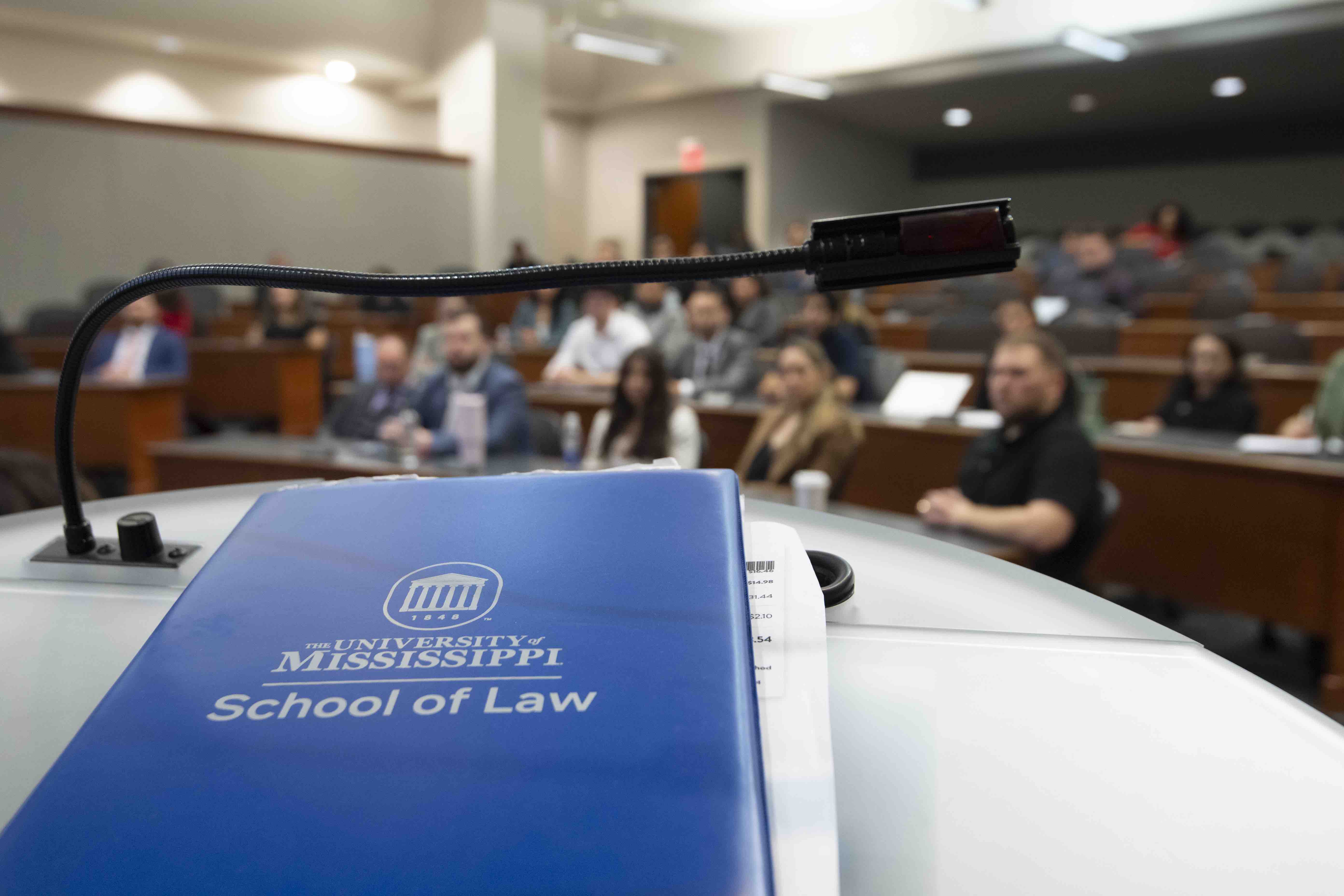
UM’s entering class of law students is a melting pot of diverse individuals, all coming together as lawyers in training.

In this year’s entering class of 189 enrolled students, 62 schools and 36 majors are represented. Students profiled here have earned degrees in such varied fields as biology, education, accountancy, history, management information systems and modern languages before applying for law school. They have had professional experience as well, in jobs ranging from teaching Japanese children to read English and finding jobs for homeless people to playing for an NFL team.

Regardless of prior experience, these first-year law students agree that one of their greatest challenges is navigating a battering sea of information.

“It’s a tremendous amount of information in a short period of time. You can’t wait to prepare for exams a week out,” said Charles Copeland of Madison, Miss.

“Right now, it’s real tough,” said Jesse Mitchell, a Moss Point, Miss., native. “It’s not tough as far as being able to understand, but it’s the workload that they put on you. You have to stay in tune with your reading and be well-organized and work in the right direction. Just because you’re doing something doesn’t mean you’re doing the right thing.”

First-year law students also agree that while the curriculum is challenging, the professors are interesting and helpful, and they are enjoying spending time with their fellow classmates.

“Everybody is really nice in our incoming class. We just have so much spirit,” said Kimi Tozaki from Greenville.

“Everybody is willing to help each other out,” said Susan Copeland of Athens, Ga. “It’s not this battle to the death.”

The Copelands, Mitchell and Tozaki, as well as Natalya Seay, Debra Giles and Andrew Coffman, are represented here to catch a glimpse of the multifaceted entering law class of 2005.

Kimi Tozaki
Smiling through the pain

Don’t be fooled by the dimpled smile and bubbly personality; Kimi Tozaki is tough and wise beyond her years.

The first-year law student learned to survive on her own at age 13. She kept losing and regaining each of her parents, only to lose both of them to cancer within the last four years. Yet Tozaki has taken her mother’s words to heart: “Happiness is a matter of choice. Always choose happiness.”

 “I’m one of the happiest girls you’ll ever meet,” Tozaki said. “I don’t take anything for granted. Sometimes I’m sitting in the law school, and I’m looking around and thinking, ‘I can’t believe I’m here.’

“I’ve learned not to put value on material things. Even though I want to be a lawyer and want to be financially well-off, I know that material things don’t last, and that wisdom, understanding, knowledge, the experiences that you go through, that’s what makes you rich.”

Tozaki is open about telling her off-the-beaten-path biography. Her tale began when her “very Southern” mother, Carol Ann “Cat” Miller of Greenville, Miss., joined the U.S. Navy, traveled overseas and met and married her Japanese father, Hiroshige Tozaki. Shortly after a move to Greenville, her parents divorced, and Tozaki lived with her mother and her brother, Keegan. She was 6 when they moved to Atlanta and 13 when something traumatic happened.

“That’s when my mother told me she was going to write a book. She never came back.”

For the next two years, Tozaki moved from place to place, at one point staying in a shelter and at another point paying $100 rent to a drug addict, whom she recalled would rock back and forth on the TV and throw trash and paint at the walls. Without parents or guidance, she didn’t go to school and was always in trouble. A case worker at the shelter offered to find Tozaki’s father. When she found him, he came quickly.

“So he picks me up, and I’m about 15 years old now, and I was this wild American girl, and he’s this traditional Japanese man. We didn’t really know each other, and we clashed. Basically, he [said], ‘You think true freedom is being able to do whatever you want, and that’s not true freedom, Kimi. True freedom comes from education. You need to be in school.’”

A Japanese chef, Tozaki’s father cooked his way to her heart, and they grew close. After graduating from high school, Tozaki wanted to go to Clemson University in South Carolina, but her GPA was not high enough, so her father encouraged her to go to a community college first. After going to Greenville (S.C.) Technical College for a year, she was accepted to Clemson, where she majored in history and minored in Japanese. In 2001, when she was a sophomore, she learned that her father was dying of colon cancer. She was at his bedside when he died.

“I was holding his hand, and I sang him a song he taught me in Japanese.”

After graduating from Clemson with honors, Tozaki applied to the JET (Japan Exchange and Teaching) program because she wanted to learn more about her father’s heritage. She was accepted to the program and taught English in Japan’s public school system. Although she had previously shunned her mother’s attempts at contact, Tozaki decided to forgive her and called her when she was in Japan. They became close again, and then Tozaki learned that her mother had bone and breast cancer. As she boarded a plane bound for the United States, she received a call that her mother had passed away.

Before she died, her mother, who was an Ole Miss alumna, knew that Tozaki was applying to law school and insisted she apply to Ole Miss.

“I hadn’t been accepted to Ole Miss. My LSAT score wasn’t high enough. I told her, ‘Of course, I’m going to Ole Miss.’ I lied to her.”

Touched by Tozaki’s personal statement, Barbara Vinson, director of admissions and recruiting for the UM School of Law, wrote to her and encouraged her to improve her LSAT scores. Tozaki did just that. She was accepted to Ole Miss on the day of her mother’s funeral.

These days, Tozaki has been elected a class senator and said she is learning so much in her classes that she feels like a sponge that has soaked up way too much.

“Our classes are fascinating. No one can come and take away what I learned in class today from me.”

Most students talk about what they want to do immediately after graduation, but Tozaki takes a longer view.

“I think law school is helping me reach that goal of being that old lady out on my porch that everybody wants to come talk to.”

Andrew Coffman
Taking the road less traveled

Two days after Andrew Coffman graduated from college, he drove across a picket line in a van full of homeless people.

“That was my very first day at work. It’s not a very normal first job to have,” he said.

After earning a bachelor’s degree in American studies from the University of Tennessee, the Chattanooga, Tenn., native found himself employed with a company called Labor Ready Inc., placing homeless people in construction jobs. When companies were hit by strikes, Labor Ready would replace all their workers. Coffman worked at branch locations in such places as Memphis, Atlanta, Nashville and Asheville, N.C.

“Homeless people are not the most reliable people in the world,” Coffman said. “We have a system where we can always get them to work, but you never knew what might happen once they got there. They got paid in cash every day. So that was sort of the incentive for people to show up.”

Ready to try something different after almost six years with the company, Coffman decided that law school would be more intellectually challenging, as well as eventually more financially rewarding. He applied only to Ole Miss and received The University of Mississippi Continuing Legal Education Scholarship in Law.

“I know a graduate of the school [who] spoke highly of the faculty and the university’s efforts to improve the quality of their educational opportunities. I was also really interested in living in Oxford, as it seems to be the perfect town to write a novel and get rich and famous,” Coffman said.

Coffman is quick with a joke and a laugh, so he may or may not be kidding when he said that he expected the classes to be conceptually difficult, but it turns out that maybe lawyers aren’t really that much smarter than the average person.

He did, however, seem sincere when he talked about his favorite classes.

“I started school in the summer and had a chance to take Dr. [Jack] Nowlin’s Criminal Law class. He is probably the best professor that I have ever had at any level. I also had professors in Property and Civil Procedure who were able to make dry subjects interesting. I like any classes where the professors laugh at my jokes.”

Debra Giles
Seeking knowledge and justice

Debra Giles has two loves in her life: knowledge and justice.

“I’ve always loved to study,” said the native of Greenville, Miss. “A couple of people tease me now because I’m always in the library. The library is full of knowledge, and to be surrounded by all that knowledge is a very comforting feeling.”

Her passion for justice erupted when her nephew was the unintended victim of homicide in a plot to kill someone else. The suspect was tried but not convicted.

 “Unfortunately, to this day, no one has ever served time for this crime,” Giles said.

She said she learned that jurors look to see if the victim’s family cares enough to be present during court proceedings. Attorneys look to families for support because it makes their job easier, but family members find it difficult to sit through a trial when they are grieving.

“But the thing is, you have to deal with that,” Giles said.

Giles also grew more interested in law when she was a domestic violence and sexual assault investigator for the 4th Circuit district attorney in Greenville. She said she was excited to help try domestic violence and sexual assault cases, but she did not always see that enthusiasm in attorneys.

“The cases could be emotionally draining, especially when having to deal with so many as we have had to do in Washington County over the last couple of years,” Giles said. “That was one thing that really pushed me over the edge [and told me] it’s definitely time to go to law school. I would really get into disagreements with the attorneys. I mean they were very amicable disagreements. I would tell them to get excited, get motivated. I tried to prepare the case as much as possible for them so that they wouldn’t get burned out.”

Before entering the UM School of Law with the help of a minority scholarship, Giles stacked up an impressive curriculum vitae, which includes a bachelor’s degree in cell and molecular biology from Tulane University and two master’s degrees, one in nutritional science-biochemistry and another in environmental health science-toxicology, from the University of Alabama at Birmingham.

She also completed course work for a Ph.D. in health policy and management from the University of Iowa and accumulated research and teaching experience.

Giles worked as a clerk for the district attorney’s office in Greenville in high school and during summers and holidays while in college. There, she met three mentors: Greenville district attorney Joyce Chiles, Youth Court judge Vernita King Johnson and former Greenville district attorney Frank Carlton. Johnson and Carlton are Ole Miss alumni.

Giles said she sees herself as a prosecutor, maybe a judge or even a politician someday, but never as a criminal defense attorney where she would have to take a case even if she knew the defendant was guilty.

“Especially when the case involves a child that was murdered or sexually assaulted. I think that that would be extremely difficult for me to do, just because I’ve seen the other side. I’ve had a family member murdered.”

Charles and Susan Copeland
Studying the family way

Charles Copeland mentions that he keeps a picture of his newborn tucked away in his torts book as he and wife Susan Copeland head to class.

The Copelands had a baby girl Oct. 11, and they are both entering law students who take all their classes together. While that scenario might be stressful for some couples, the Copelands seem to take it in stride.

“I’m high-strung. He’s laid back. We make a good team,” said Susan, who did not take any maternity leave because she preferred not to fall behind in her law studies.

“We’ve grown a lot closer being together all the time,” Charles said. “It’s been really good for our marriage.”

Besides their newborn, Rainey, the Copelands have a 2-year-old daughter, Carlisle. They said attending law school would not be possible without the support of family and friends, and they consider themselves extremely lucky.

 Both received undergraduate degrees from Ole Miss in 2000. Charles received a Bachelor of Business Administration with an emphasis in management information systems, and Susan received a Bachelor of Business Administration in finance and a Master of Arts in higher education administration.

After graduation, they moved to Memphis, where he wrote software for International Paper and she worked as an auditor with FedEx Corp. They returned to Oxford after being away for only 18 months. He then worked for FNC Inc., and she stayed home and taught the LSAT review for Kaplan Inc.

“We’ve been here for so long. It’s just home. It’s comfortable,” Susan said.

She said she sees herself as a professional student and possibly would like to teach law or become an attorney within higher education. She received the Tim Angle Scholarship in Law and the UM School of Law Scholarship.

Charles did not necessarily intend to follow in his father’s footsteps, he said. His father, Greg Copeland, is an attorney with Copeland Cook Taylor and Bush and an alumnus of UM’s law school.

“I’ve kind of always told myself I wanted to go to law school. I really like technology and writing software, but I realized it’s not what I wanted to do for the rest of my life. I saw billing contracts that were terribly written and saw the need for a lawyer who understands the software side of things.”

Jesse Mitchell
Choosing a new game plan

Jesse Mitchell played only eight games as a defensive end for the Baltimore Ravens before an injury sidelined him, but he said he did accomplish one goal.

“I got a sack in the NFL. That is something that I’ll cherish for the rest of my life.”

Were it not for a knee injury, Mitchell still might be a Baltimore Raven rather than an Ole Miss law student. After his sixth knee surgery, Mitchell said he knew he had to decide whether to continue his football career or enter a career that could last a lot longer.

“I’ve always known that I wanted to go to law school, so I decided to take the LSAT. I did well enough to get into law school, so I made the decision that football had to come to an end someday, and now I’m here.”

When it came time for Mitchell to decide where to go for his undergraduate degree, he also was deciding where to play college football. Everyone thought he would follow his brother, Kareem, to LSU. Kareem Mitchell was a defensive tackle for the Tigers but told his brother he would be treated more fairly in state.

Mitchell happened to have a couple of significant connections to Ole Miss. In high school, he worked for Calvin Taylor, an UM alumnus and criminal defense lawyer on the Gulf Coast. Also, one of his elementary and junior high teachers was UM Chancellor Robert Khayat’s sister.

“I had a close relationship with the chancellor and his family. With the ties I had to Ole Miss and [because] Ole Miss had a prestigious law school, that sealed the deal.”

During his undergraduate years, Mitchell was a defensive lineman for the Ole Miss Rebels. He was named first team All-SEC by the Associated Press in 2003, and he received many accolades, including the 2003 John Howard Vaught Award of Excellence, presented to honor the senior athlete who exemplifies the qualities of dedication, scholastic ability, morale and performance.

Mitchell said that being a part of the legendary 2003 football season was something special.

“I don’t think we really fathomed that we would have a 10-3 season, to go out as one of the best classes to play here in awhile.”

Mitchell received a Bachelor of Accountancy from Ole Miss, following in the footsteps of his role model, Taylor. During the summers, he had a chance to work for Richard Scruggs, UM alumnus, tobacco settlement attorney and senior partner in the law firm of Scruggs, Millette, Lawson, Bozeman and Dent in Pascagoula, Miss.

“They do a lot of class action litigation. I think that’s the area that I’m moving toward. You know a lot of people say, ‘He’s doing it because that’s where the big bucks are.’ At the same time, you’re doing a greater good for the public.”

Mitchell spends a lot of time in the library these days, but he loves to hunt and fish when he gets a chance. He has a fiancée, Darrlyn, and a son, Jayden, who just turned 1. While football has played a major role in his life since the third grade, law also clearly played a part in his life early on.

“My parents would say, ‘You always try to plead your case as if you were a lawyer.’”

Natalya Seay
Riding the freedom train

Whereas law students who were born in the United States might take freedom for granted, Natalya Tykhonovska Seay brings a fresh eye and an appreciation to the study of the U.S. Constitution and American government and law. 

Seay was born in a Ukrainian village called Chkalovo and as an 11-year-old girl witnessed Ukraine’s declaration of independence and the dissolution of the Soviet Union in 1991.

“I know firsthand what it is like to live in a country without rule of law,” Seay said. “I know what it is to be denied basic civil rights such as being able to vote freely or be denied opportunity because corrupt officials demand bribes. In my study of American government, I learned that no one, including the president of the United States, is above the law.”

She said that lawyers can help ensure that people know their rights so that they cannot have freedoms taken away.

Seay arrived in the United States in 2003 and lived in Kosciusko, Miss., before coming to Ole Miss. Her husband is an attorney. Familiar with his law practice, she said, “I have observed the needs of his clients and learned how much a good lawyer can do to help people protect their rights.”

Seay’s analytical mind has helped her to study languages, including the language of the law. Her native languages are Russian and Ukrainian, and she studied English, German and world literature at Kherson State Pedagogical University from 1997 to 2002 under a full tuition scholarship. She received a Diploma of Specialist, which is the equivalent of a U.S. bachelor’s and master’s degree. While there, she tutored children in English.

In Oxford, before entering law school, she took 15 hours of journalism courses, education courses in TESOL (teaching English as a second language) and was assistant instructor of Russian for the UM Department of Modern Languages in 2004.

While researching law schools, Seay said she found that the Ole Miss School of Law is unique in that full professors teach relatively small classes. She said one of the main rewards of law school so far is her friendship with fellow students.

“Our entering class is composed of outstanding students from all over America. Just in my section of the first-year class, there are former student body presidents, leaders and scholars from many outstanding universities.

“I especially enjoyed the 14 friends I made in the Ole Miss law school summer courses. They are my buddies.”

—Benita Whitehorn is assistant director of publications at UM.


back to topUMLawyer home