Symposium spotlights disability law
on 15th anniversary of the ADA

When passed in 1990, the Americans with Disabilities Act was hailed as “the world’s first comprehensive declaration of the equality of people with disabilities” because it guaranteed that every man, woman and child with a disability could “now pass through the closed doors, into a bright new era of equality, independence and freedom.”

To mark the 15th anniversary of the act’s passage, the UM law school brought together for a November symposium several leading scholars in civil rights and disability law to examine how effective the act has been in prohibiting discrimination on the basis of disability.

“Fifteen years [later], this is an appropriate time to reflect on the gains made and the challenges that still remain under the Americans with Disabilities Act,” said Michael Waterstone, assistant professor of law and organizer of the symposium. “The ADA was built on the models of earlier civil rights laws that came before it, but it also created different types of legal protections for people with disabilities.”

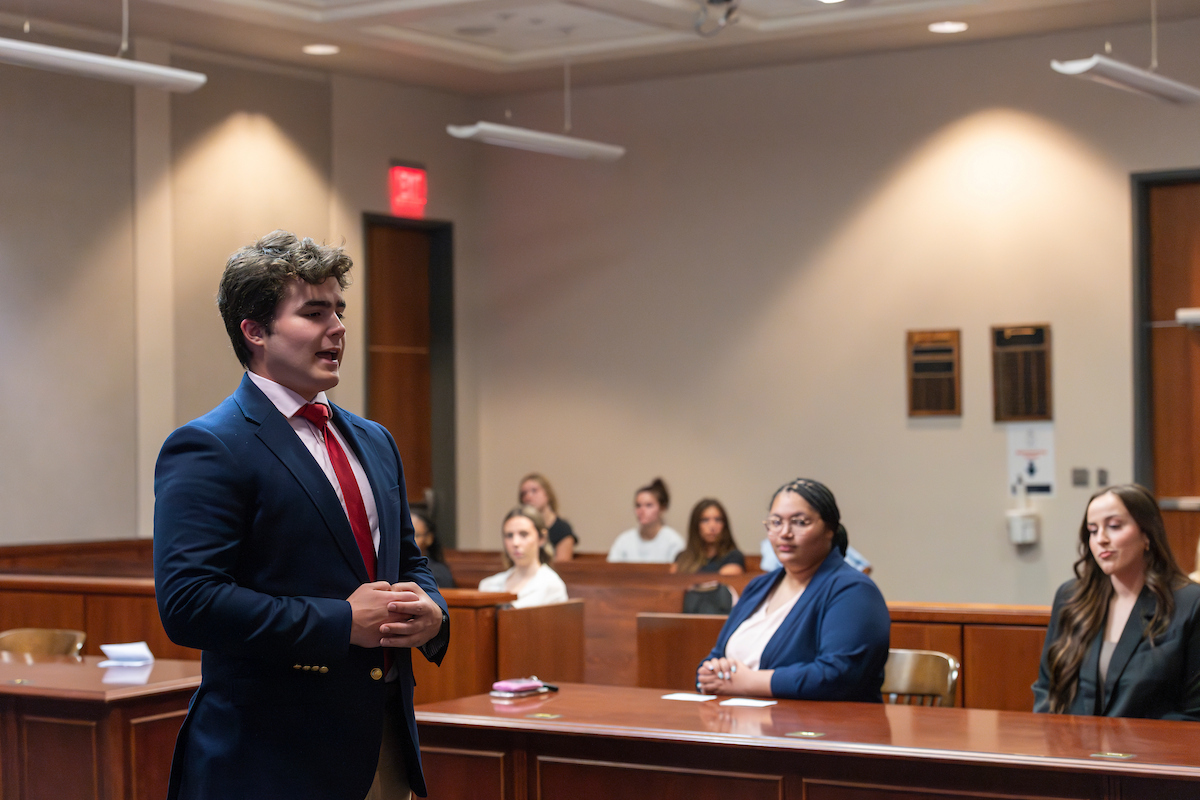
Panelists gathered before a crowd in the William N. Ethridge Jr. Moot  Court Room and informally presented their views on the role and influence of the ADA.

University of Iowa and Syracuse University law professor Peter Blanck said, “Right now the ADA is at an interesting crossroads between effectiveness on range and reach of the law. With a new Supreme Court composition, there may be new unforeseen opportunities and challenges.”

The symposium addressed how recent ADA issues affect the millions who live with disabilities.

“Many do not work, live in poverty and do not have adequate health insurance and transportation,” said Blanck, who discussed the new landscape of ADA into the next 15 years and the employment and civil rights of people with disabilities.

“What is it going to take to empower people with disabilities?” asked Blanck, who also recognized the success of the ADA, which has been modeled around the world.

Panelist Miranda McGowan of the University of San Diego School of Law, whose research focuses on employment discrimination and constitutional law, discussed hardships faced by people with disabilities when seeking jobs.

“Recent research [indicates] the ADA has not reduced the level of unemployment among people with disabilities,” McGowan said. “Employers find it too expensive to hire and fire disabled people, thus employers don’t make the initial hire.”

Despite the difficulties they face in the workplace, people with disabilities rarely file class action lawsuits, said professor Michael Stein of Harvard and William and Mary law schools.

“People with disabilities are insular and discrete,” said Stein, who argues in favor of pan-disability. “Stereotypes have affected the entire group. If there’s group-based discrimination, there ought to be group-based action and a group-based remedy.”

The diverse group of scholars discussing issues of disability law and policy included law professors Kaaryn Gustafson of the University of Connecticut, Ann Hubbard of the University of Cincinnati and Camille Nelson of Saint Louis University. Blanck, Stein and Hubbard are the leading voices in disability law scholarship, while professors McGowan, Gustafson and Nelson are experts in related civil rights fields.

Disabled two years before the passage of the ADA, Gustafson would like to see the disability rights movement reinvigorated.

“I think of the ADA as a manifestation of the civil rights movement,” she said. “It loses steam once the claims are incorporated into the statute.” 

Measures of disability should be included in standard surveys to make people aware of disability and take it more seriously, Gustafson said. “At some point we’re all likely to have a disability, yet it is so stigmatized.”

“I think the ADA is all about stigma—stigmatized conditions,” Hubbard added. “People don’t take a hard look at their actions toward people with disabilities because they think they are acting out of good will. They think pity.”

The ADA has been crucial in explaining and protecting the civil rights of people with disabilities,” said UM’s Waterstone. It has created great advances in employment, access to public accommodations and participation in public programs, services and activities.

“Yet the ADA’s impact on many of the important policy issues of our day—things like health care, integration into a more flexible labor market and access to technology—is still unclear,” he said.

Papers from the symposium will be published in the Mississippi Law Journal.

—Natashia Gregoire, a communications specialist in UM’s Office of Media and Public Relations, is editor of UM Lawyer


back to topUMLawyer home