New Sea Grant Director Hopes to Strengthen
Partnership Between Mississippi and Alabama
Stephanie Showalter, former research counsel at the UM Law Center, has been named director of the National Sea Grant Law Center and the Mississippi-Alabama Sea Grant Legal Program, both also under the auspices of the Law Center.
In her new post, Showalter is responsible for providing legal assistance to organizations and government agencies with interpretation of statutes, regulations, and case law. She also makes presentations at national conferences and symposia.
“I am very honored to be selected as the new legal director,” Showalter said. “By building on the experience I gained as staff attorney, I hope to strengthen the partnership between Mississippi and Alabama, as well as all coastal planning agencies and user groups.”
The director also advises citizens on coastal and law issues; supervises law student research projects; and publishes papers concerning natural resources, marine, and environmental law issues. She is editor of the monographs The SandBar and The Sea Grant Law and Policy Digest.
Plans call for extending Sea Grant research service to other sectors, such as industries and state agencies across the nation. At the same time, programs will remain loyal to their roots, providing information about marine-related laws and regulations to the coastal community, Showalter said.
Showalter joined the Law Center’s Mississippi Law Research Institute as research counsel in September 2002. She received a bachelor’s degree in history from Penn State University and a joint Juris Doctor/Master of Studies degree in environmental law from Vermont Law School.
The Mississippi-Alabama Sea Grant Legal Program was founded in 1972 and operates in association with the National Sea Grant Law Center designated at UM in February 2002. Sea Grant provides legal research, outreach and advisory services, education, and training. The national center works with 30 state programs and universities to encourage the wise stewardship of marine resources.
“The Sea Grant Law Center is always willing to pursue partnerships with any organization or individual involved in coastal research,” Showalter said.
Showalter follows Kristen Fletcher, who served as inaugural director of the national center. Fletcher now is director of Marine Affairs Institute and Rhode Island Sea Grant Legal Program at Roger Williams University School of Law.
A Good Conversationalist
Harry T. Edwards (left), chief judge emeritus of the United States Court of Appeals for the District of Columbia Circuit, hosted the Black History Month special event “A Conversation with Harry T. Edwards” at the Law School. His presentation was the inaugural Sherman L. Muths Jr. Lecture in law.
Law School Dean Samuel Davis (right) describes Edwards as a “highly respected member of the academy and the bench.”
Edwards, who was appointed to the U.S. Court of Appeals by President Jimmy Carter in 1980, served as chief judge from 1994 to 2001. Before his appointment, Edwards was a tenured professor at the University of Michigan and Harvard law schools. He also has taught at several other law schools, including Duke, Georgetown, Pennsylvania, and, most recently, New York University.
The lecture series was established by UM law graduate Sherman L. Muths Jr., a practicing attorney in Gulfport.
More IN THE NEWS • UMLawyer Summer Home
Mutual Funds Big Guns Gather at UM
A successful future for the embattled mutual funds industry depends on whether regulators, owners, and other industry officials can regain and maintain investor trust, a panel of influential industry experts said during the Mutual Funds Summit earlier this year.
The summit, hosted in January by the UM School of Law and Fund Democracy, brought together for the first time advocates, regulators, and industry representatives to discuss major issues in the $7.3 trillion funds industry.
“Americans need mutual funds,” said panelist Don Phillips, managing director of Morningstar Inc., a global investment research firm. “They need to know when they put their money in that investment vehicle, they can trust them.”
Regulators agree. “If the industry is to be successful 10 years from now, investors need to have confidence in regulators, owners and managers,” said Paul Roye, director of the Securities and Exchange Commission’s Division of Investment Management.
Even before news of improper practices within the normally scandal-free world of mutual funds started grabbing headlines last year, UM law professor Mercer Bullard, a former assistant chief counsel for the SEC, called on his colleagues to assemble in Oxford for the summit.
“This is a group of people who talk at each other through the press,” said panelist Paul Haaga Jr., vice president and director of Capital Research and Management Co.
The elite panel of 11 included John Bogle, founder of the Vanguard Group, one of the world’s two largest mutual funds organizations; SEC commissioner Harvey Goldschmid; and Barbara Roper, director of investor protection for the Consumer Federation of America.
The panelists, representing various sides of the issues, debated back and forth on topics including investor fees, the need for point-of-sales fee disclosure, and the role of independent directors.
“We’ve taken a nice, simple business and made it into the business of witchcraft,” said Bogle, who calls for the industry to return to simpler, more honest times.
Bogle, whose company Vanguard boasts some of the lowest fees in the industry, argued that investors’ returns are being reduced by ridiculously high broker charges. Mutual funds, he said, don’t need the “complexity and confusion and salesmanship” in the market.
Debating on behalf of consumers, Roper said investor costs have been driven up by competition. Many costs, Roper charged, are deliberately hidden by brokers posing as advisers.
Linda Dallas Rich, senior counsel for the Committee on Financial Services in the U.S. House of Representatives, said, “brokers need to reveal incentives that they have to sell certain funds.”
Goldschmid and Paul Roye, the SEC representatives on the panel, agreed that the industry desperately needs change. Questions of how much change, and where it should be implemented, fueled the discussion.
“This is an ultimate challenge for the commission,” Roye said of the SEC’s efforts to improve disclosure and provide consumers with accurate information about their investments.
With the industry undergoing its most sweeping overhaul since the 1940s, regulators should not become overzealous, said attorney Barry Barbash of the international firm Shearman & Sterling, LLP.
“I am concerned with the amount of regulation,” Barbash said. “It will be great for funds lawyers but not for entrepreneurs.”
Lawmakers will have the biggest impact on the future of the industry, said panelist Craig Tyle, general counsel of the Investment Company Institute.
“The biggest determinant is how the issues currently before Congress and the SEC are resolved in a year or so,” Tyle said.
But Eric Siri, associate professor of finance at Babson College, said, “In the end, the best remedy is an informed consumer.”
John Rogers, chairman and chief executive of Ariel Capital Management Inc., agreed that investor education is the key, particularly for minority investors. “People of color are less likely to get involved in the market,” Rogers said. “We need more diversity in our industry, on our funds board, and in management.”
The panelists debated before a packed house in the Law Center Moot Courtroom.
“It certainly lived up to our expectations,” said law Dean Samuel Davis. “This would not have happened without professor Bullard’s outstanding leadership.”
Bullard, a frequent contributor to national debates, said the summit was “the best discussion of mutual funds I have ever seen.”
More IN THE NEWS • UMLawyer Summer Home
U.S. Can’t ‘Jettison Constitution to Preserve It’ Says Fourth Amendment Expert in First Otis Lecture
The Fourth Amendment was not intended to make it impossible for citizens to protect themselves from real terrorist threats, said law professor John Burkoff, who delivered the inaugural James Otis Lecture at the Law School.
Burkoff, a nationally recognized Fourth Amendment scholar, is associate dean of academic affairs and a law professor at the University of Pittsburgh School of Law. His speech, “A Flame of Fire: The Fourth Amendment in Perilous Times,” addressed the difficulty lawmakers face in upholding constitutional commitment to the protection of individual rights, especially Fourth Amendment rights, in the face of credible terrorist threats.
Burkoff’s lecture drew on recent Supreme Court decisions to answer the question: “How can we protect our sacred Bill of Rights and protect our collective safety at the same time?”
“Our response to such dire and dramatic threats to us and to our nation and to our national identity and character should not be—it cannot be—to ignore our own history, to ignore our own laws, or to ignore our own constitutional principles,” Burkoff said. “What sense does it make to jettison our Constitution to preserve it, to ignore our laws to uphold them, or to abandon our integrity to save it?”
Sponsored by the National Center for Justice and the Rule of Law at UM, the annual lecture series focuses on search and seizure principles and is part of the center’s Fourth Amendment Initiative.
“The Fourth Amendment has more to say than any other part of the Constitution about our liberties,” said Thomas Clancy, the center’s director. “It is implicated every time the police stop a car, arrest someone and search a bag, and in airport screening and drug testing. The average person has more day-to-day contact with this part of the Constitution than perhaps any other.”
Burkoff said the NCJRL has become the leading venue to analyze, discuss, and train in cutting-edge issues in Fourth Amendment law. “I’m truly honored to have been invited to be a part of that effort,” he said.
The lectures honor James Otis, the man who ignited the American Revolution and whose words inspired the Fourth Amendment.
More IN THE NEWS • UMLawyer Summer Home
Fond Memories of Provost Staton’s Law School Days
Inspire Alums to Create Scholarship in her Honor
While on campus recently for a 10-year reunion, the School of Law class of 1994 announced the establishment of a scholarship endowment honoring UM Provost Carolyn Ellis Staton.
Many members of the class have fond memories of Staton, who served as a law professor during their first two years and was named acting dean during their third year. Class members contributed $35,000 to establish the endowment, which has grown to nearly $40,000 in gifts and pledges.
“The reason we really wanted to do something for her was because when we were at the Law School, she was just such a major part of the school,” said alumna Deanne Mosley, who challenged her former classmates to contribute. “We couldn’t imagine going through Law School without her being there, so we decided if she couldn’t be there physically, she will in spirit.”
Staton, a Vicksburg native, left the Law School when she was appointed provost and vice chancellor for academic affairs in 1999.
Mosley said her classmates were impressed by the personal interest Staton took in students and wanted to honor her in a way that would touch other students.
One student entering Law School this fall will receive the first Carolyn Ellis Staton Scholarship in Law. The three-year scholarship will be awarded to an incoming law student once every three years.
I am impressed that the members of the class of ’94 raised so much money within their own group to honor one for whom they have great respect and much love,” said Dean Samuel Davis.
More IN THE NEWS • UMLawyer Summer Home
UM, National Judicial College Collaborate
on Task of Training Nation’s Judges
Strengthening the country’s judicial system is the thrust behind an agreement between The University of Mississippi and the National Judicial College at the University of Nevada-Reno.
Representatives from the two institutions gathered on UM’s Oxford campus in January to reveal the affiliation between the Mississippi Judicial College, part of the UM Law Center, and NJC to coordinate administering judicial education throughout the country. MJC Director Leslie Johnson will lead the effort.
It’s a collaboration that “we have been looking forward to for some time,” said William F. Dressel, NJC president. “Our organizations share a common goal of empowering our nation’s judiciary to meet the everyday challenges of serving on the bench. We look forward to this mutually beneficial collaboration that will focus on enhancing skills, productivity, and proficiency for the nation’s judiciary.”
UM Chancellor Robert Khayat agreed. “The National Judicial College and the Mississippi Judicial College have led the nation in judicial education. This partnership will add strength to both programs. We commend Dr. Leslie Johnson on his visionary leadership.”
Mississippi became the first state in the nation to begin a full-time, statewide judicial education effort with the 1971 Law Enforcement Assistance Administration grant to MJC. The college was created at the UM Law School the year before, with support from the Mississippi Supreme Court and the National Judicial College. Since its establishment in 1963, NJC has awarded more than 61,000 professional judicial education certificates.
“With the Mississippi Judicial College located here, and now the affiliation with the National Judicial College, the Law Center is at the forefront in offering continuing legal education for judges,” said Dean Samuel Davis.
MJC for many years has met the state’s judicial education needs, annually training some 2,000 members of the judiciary, including state supreme court judges and appellate court judges, as well as those serving in chancery, circuit, county, justice, and municipal courts.
“This new affiliation with the National Judicial College broadens our national scope and will allow Mississippi judges to attend these programs at a greatly reduced cost,” said Johnson, who was appointed MJC director in 1992 after spending some 18 years in the Alabama judicial system.
Judge Sebe Dale of Columbia, who serves on MJC’s board of directors, also applauded the union. “The opportunity for the Mississippi Judicial College to become a working affiliate with the National Judicial College is not only a signal honor to MJC and to The University of Mississippi School of Law, but, more importantly, it also affords us a significantly enhanced opportunity and ability to expand our impact in the continuing judicial education field in both our state and our region of the nation.”
While it is not a requirement, judicial training is especially important in Mississippi and the 12 other states that allow nonlawyer judges to serve, Johnson said. “The training is certainly beneficial and naturally, all judges are encouraged to attend,” he said.
Funding for the national seminars is to be generated through tuition, and Johnson said he doesn’t expect to hire additional staff or to add office space. Some training will take place at the UM Law Center.
More IN THE NEWS • UMLawyer Summer Home
Commencement 2004
Measure Up
Bar president challenges grads to make fellow lawyers proud
By Natashia Gregoire
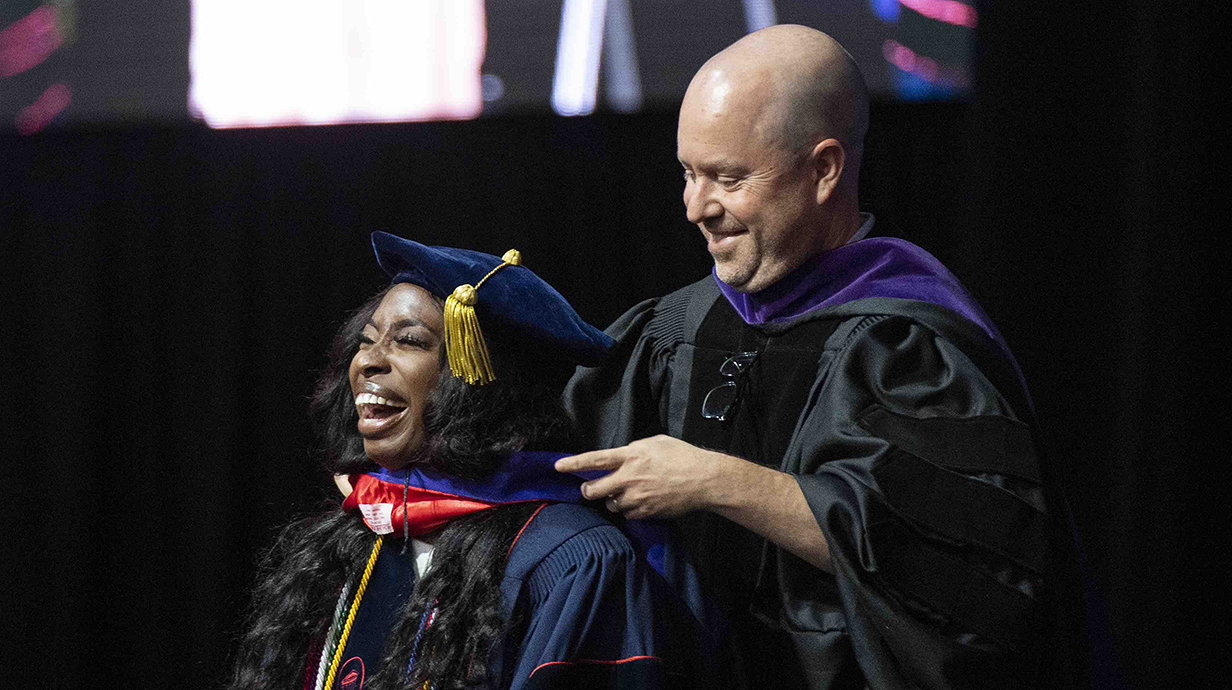
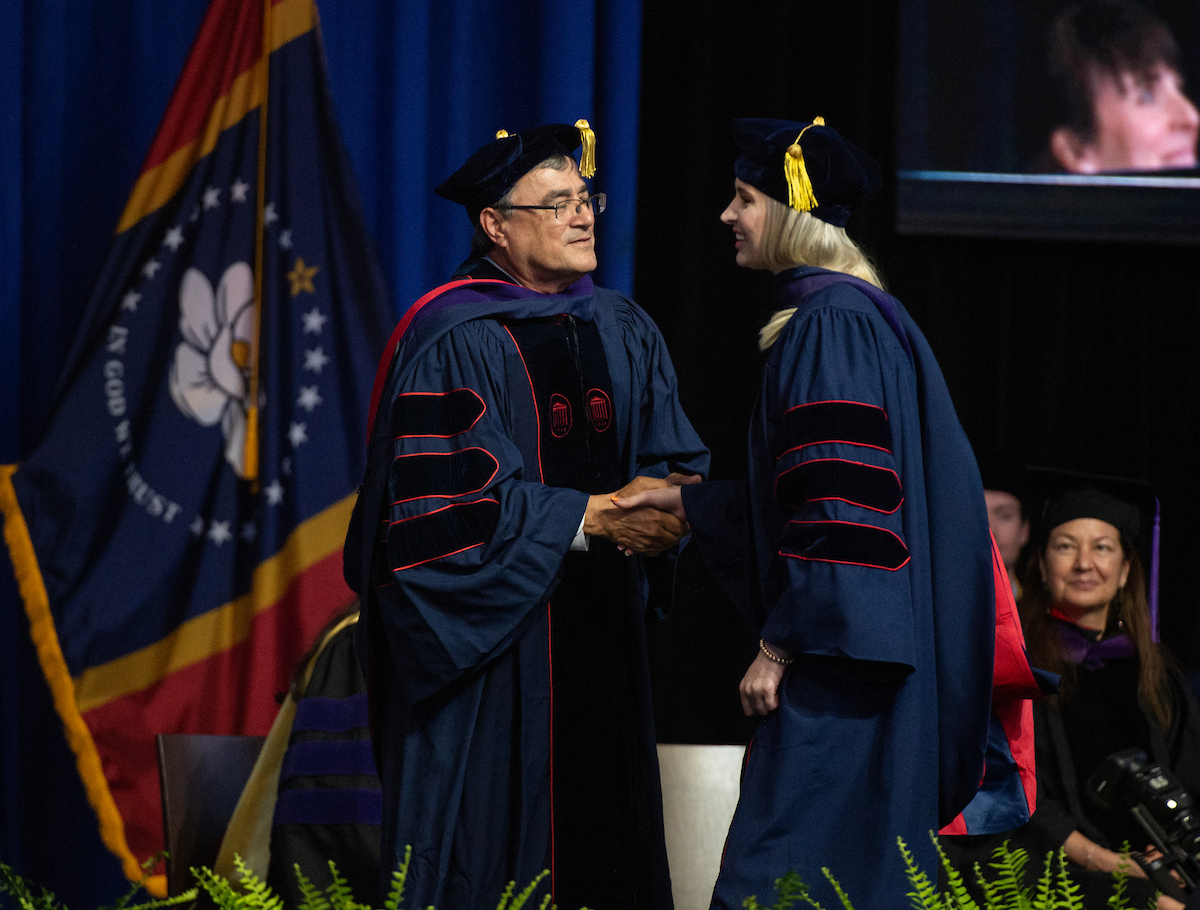
Strive to attain the full measure of a lawyer was the challenge commencement speaker Richard C. Roberts III (’73, ’76) issued to the Law School’s 2004 graduating class at the May 9 ceremony.
“To attain the full measure of a lawyer takes time, desire, and work,” Roberts said to the 145 May and December graduates, reminding them to consider the responsibility they have as lawyers.
“People come to us in their time of need,” said Roberts, a Jackson attorney and president of the Mississippi Bar. “They have real problems, and they are seeking your help and your advice, and relying on your skills and abilities to help them with those problems.”
Roberts told the graduates that to attain the full measure of a lawyer, they must remain students of the law.
“The next time you are up at 2 a.m. poring over the Rules of Evidence … it will be in preparation for direct or cross-examination of a real witness the next day at trial,” Roberts said. “There won’t be an exam grade, but everyone in the courtroom will be grading you—the judge, the jury, opposing counsel, the witness, and your client. Everyone will know if you put in the work to properly represent your client.”
Throughout his remarks, Roberts stressed the importance of maintaining a solid professional reputation. “Go out and earn the reputation of being an honest, hard-working, and courteous lawyer,” he said. “Treat your reputation as the treasure that it is. Guard it, protect it. Keep it polished with your good character.”
Roberts challenged the students to follow the examples of the “great lawyers” who have graduated from UM. “They are known as skilled workmen in the law, and, as promised, they have stood before presidents and governors and senators and other rulers in human government,” Roberts said. “Make your families proud of you. Make your fellow lawyers proud of you.”
Each year, the Law School invites the president of the Mississippi Bar to deliver the commencement address. In practice for more than 28 years, Roberts owns his own law firm in Jackson. He practices in the areas of divorce law, employment law, personal injury, and general business litigation. He also has served as president of the Mississippi Chapter of the Federal Bar Association and president of the Hinds County Bar Association.
Natashia Gregoire is a communications specialist in the UM Office of Media and Public Relations.
More IN THE NEWS • UMLawyer Summer Home |