Legal Road Show
Appeals Court jurists share experience
and advice with UM law students

Notes from the Author

Yearlong Celebration of Sesquicentennial
Kicks Off with Matthews Lecture

Reflections
- Parham Williams
- Tom Edmonds
- David Shipley
- Josha Morse
- Guthrie Abbott

View from the Mountaintop

Breaking One Barrier at a Time


Legal Road Show
Appeals Court jurists share experience and advice with UM law students
by Natashia Gregoire

Since most cases are lost rather than won on appeal, attorneys need to be prepared to put forth their best arguments. That was advice offered by judges with the U.S. Court of Appeals for the 5th Circuit during a recent visit to Oxford.

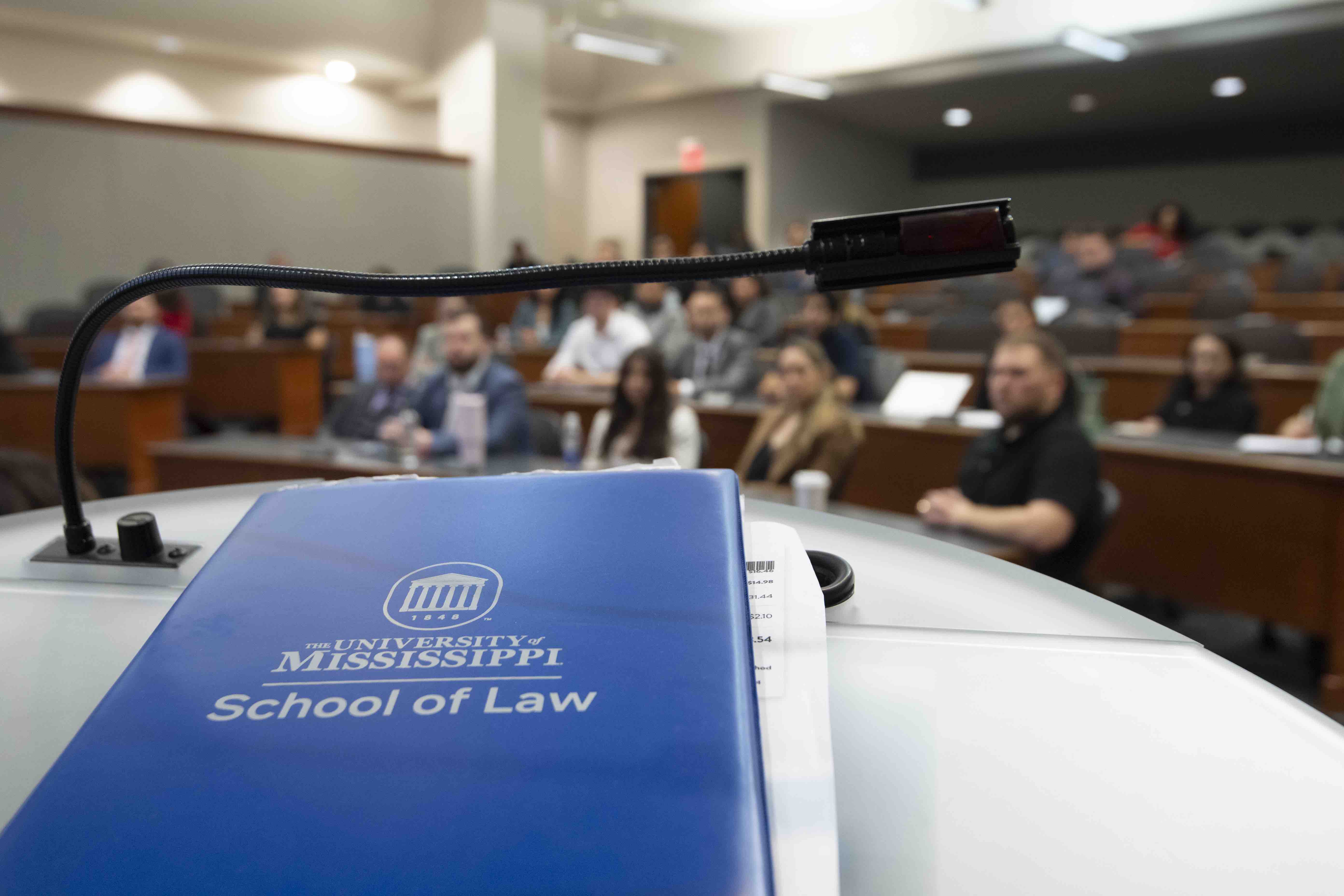
The court convened on the Oxford campus in October, giving law students a firsthand view of how appellate court proceedings operate.

Judges Rhesa Barksdale and Grady Jolly, both of Jackson, and Judge Will Garwood of Austin, Texas, heard legal arguments in 13 cases during their four-day visit.

“The 5th Circuit heard many significant appeals from the three states in its jurisdiction on the civil as well as the criminal side,” said Dean Samuel Davis. “Many of these cases end up in the United States Supreme Court, and we got to see a preview of cases that might become landmark decisions.”

Headquartered in New Orleans, the court’s jurisdiction covers Mississippi, Louisiana and Texas. The judges heard oral arguments in seven cases from Texas, three from Louisiana, two from Mississippi and one from the U.S. Tax Court. Since the 1980s, the court has scheduled sessions at law schools to give students the opportunity to see this branch of the federal court in action.

“The 5th Circuit’s presence here every three years provides a great educational opportunity for our students as well as our faculty,” Davis said. “Our students get to see some of the best lawyers, and some of the best appellate judges, at work. We are grateful for the court’s continued willingness to afford us this rare opportunity for learning.”

The court does not conduct trials but hears arguments from lawyers on each side of the appealed cases. Eighty percent of the court’s cases are heard in New Orleans. This was its sixth session at UM in recent years.

“Every judge in our court wants to come to Oxford,” Jolly said. “Rotation is designed to give each student one opportunity to see how arguments are made before they graduate.”

Law students sat in on the hearings and saw the judges in action. In a session designed for the students, the jurists answered questions about their work and advised the future lawyers always to be prepared.

“You should be well-advised to know how the court does its business,” said Garwood, the senior judge on the panel. “Most judges will read the briefs but not the record .… We’ll probably have some questions about what the record shows, and you should be prepared to answer those.”

Lawyers have 20 minutes to present their arguments and need to make the best of that time, the judges said.

“You may have worked on a case for five years, but then you get 20 minutes to defend or to attack that case in appellate court,” said Jolly, a 1962 graduate of the law school. “You need to have everything going for you. If you’re trying to fudge or you’re trying to fake, you lose credibility.”

Barksdale, a 1972 UM law alumnus and the junior judge on the panel, added, “We can respect ‘I don’t know,’ but we can’t abide being disingenuous or misrepresentations.”

Jolly said lawyers need to “be candid, be truthful and know everything you need to know about the record.”

Garwood advised the students to start making preparations for appeals even while they’re trying cases in district court.

“We are limited by the record,” Garwood said. “If it’s not in the record, it never happened. Try your case in district court, because you cannot try it in appellate court.”

Lawyers coming before the court need to have realistic expectations, as federal court is a court of limited jurisdiction, Barksdale said. “There’s not a remedy for every wrong in federal court,” Barksdale said.

With several judges appointed by conservative presidents, the 5th Circuit is often considered a highly conservative court. Jolly and Garwood were appointed by President Ronald Regan and Barksdale by President George H.W. Bush.

“Judges are objective,” Barksdale said. “As factious as the appointment process can be, it works extremely well. You cannot divorce yourself from the real world.”

Jolly said, “Ninety five percent of our cases will not be affected by who we are.”

Law students said seeing the judges in action puts their lessons in perspective.

“It brings to light what we’re studying to do here,” said third-year law student Jim Kutkowski of New York. “It’s actually better to see it done in action. It’s really good to have an idea of how the procedure goes.”

Meta Poole, a third-year law student from Jackson, said she sat through some hearings and found them to be informative. “It was interesting to see how the attorneys handled themselves,” Poole said. Some were nervous, some were at ease. I was delighted at the judges’ charm.”

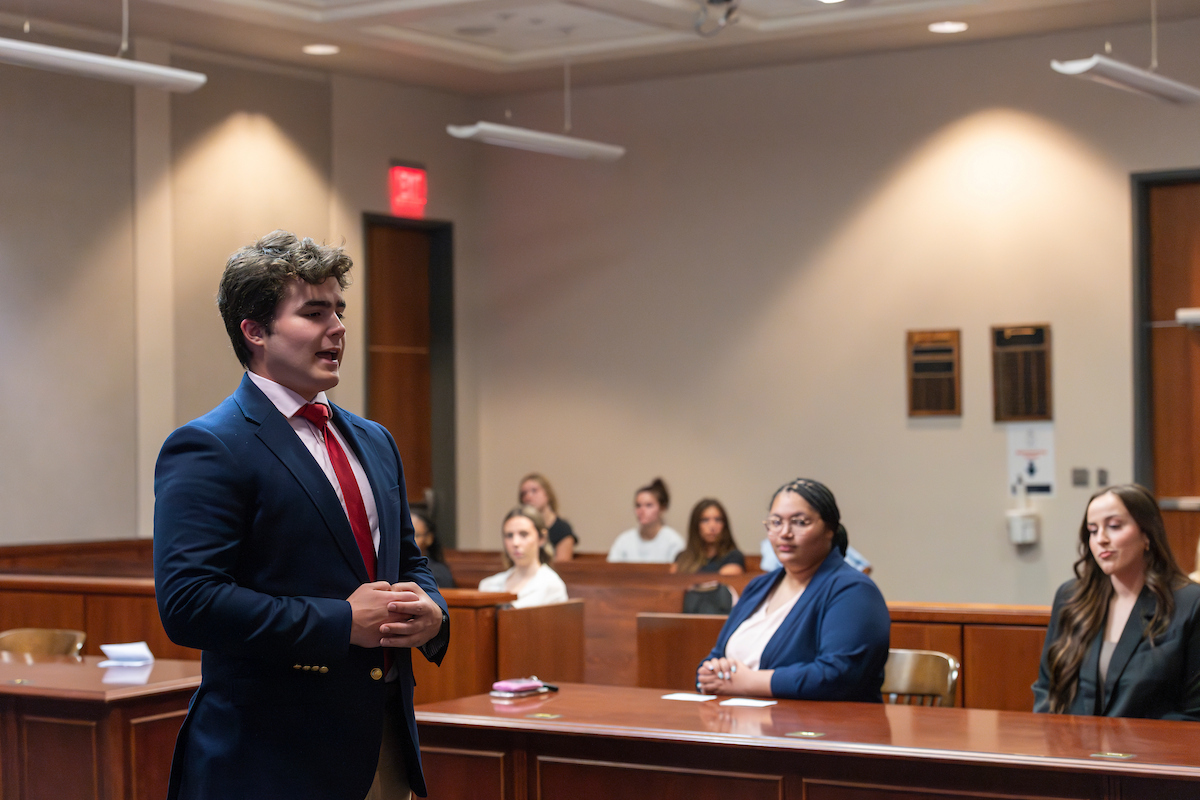
For more than an hour, the panel of judges took questions from students who had gathered in the William N. Ethridge Moot Court Room. Some of those questions the panel’s responses are included below.

Q: Do you choose which cases you want to hear?
A: Cases are assigned randomly so there is no accusation of picking cases. Barksdale

Q: How often do you hear cases?
A: We hear arguments only in 25 percent of the cases that are filed. Each judge sits seven times a year. I know in the beginning of July where I’m going to sit, when I’m going to sit. Jolly

Q: How do you decide which cases are heard?
A: All it takes for a case to go to argument is for one judge to say, ‘That case needs argument.’ When cases come to us for oral argument, it means that’s an important case. Jolly

Q. Give some idea of how large your docket is.

A: We get about 3,600 cases of which 2,700 are handled by judges working with briefs and records. The other 900 we hear arguments on. We try to have a case completed within 60 days. Barksdale
A: The 5th Circuit is a very efficient court. It’s the second-largest in the U.S., with 15 judges and no backlog. The 9th Circuit is larger, with 26 judges and not much of a case-load difference. There probably is no more accurate appellate court in the U.S. than the 5th Circuit. Jolly

Q: In terms of interpreting statutes, what kind of scheme do you adopt? What part does legislative history play?
A: If the statutes are clear, not much. Jolly
A: We try to go to the statute first. If it is not clear, we go to the legislative history. Garwood

Q. Why did you accept the nomination to the court?

A: I thought it was an honor to serve. It is a productive and honorable way to spend one’s life. There were a lot more judges and lawyers more qualified than I, but the stars weren’t lined up for them. You make financial, personal and community sacrifices. Jolly
A: There has to be a president who has to be in a party in which you participated. A senator has to know you. It’s political. It was designed that way in the Constitution. You’ll give up something, but it’s a wonderful way to serve—to solve the problem and not be a part of the problem. But there are sacrifices—no writing letters to the editor, no serving on committees. Barksdale
A: It is what I was best at. There are downsides, such as the isolation you have from ordinary activities compared to if you were in private practice. Garwood

Back to top


Notes from the Author
Professor inks law school’s sesquicentennial history
by Michael Landon

In 1970, six years after I first joined the history faculty at The University of Mississippi, my first book was published by the University of Alabama Press. Its title was The Triumph of the Lawyers. In the wider world, it got pretty good reviews, and even got me elected a fellow of the Royal Historical Society of Great Britain in 1974.

Even though the book’s subtitle was Their Role in English Politics, 1678-1689, members of the Mississippi Bar evidently focused their attention on the title itself. In the spring of 1976, my good friend, professor Tommy Ethridge (the then president-elect of the Mississippi Bar), approached me on behalf of the Bar Foundation, which was looking for an appropriate project to fund in celebration of the national Bicentennial, and asked me if I would be interested in writing for them a history of the Mississippi Bar in the 20th century.

It sounded like an interesting project, and it was. With the patient advice and assistance of former bar president and foundation trustee N. Webb Overstreet, mainly over the course of the next three summers, the job was done. In the spring of 1979, The Honor and Dignity of the Profession (a phrase taken from the preamble to the bar’s Code of Ethics) was published by the University Press of Mississippi. Also I was able, after doing just a little bit more research, to write an article titled “The Origins of the Mississippi Law Journal,” which was published first in Vol. 50, No. 1, of the journal and eventually republished in the journal’s 75th anniversary issue in the fall of 2003.

While researching that bar history, I discovered not only that there had been two earlier state bar associations in Mississippi back in the 19th century, but also that the first one of them had been, in fact, the very first ever organized anywhere in the United States. It had functioned in the then-state capital, Natchez, from 1821 to 1825. And its existence had always been known about because, in 1823, it had sent a petition to Congress (duly recorded in the Congressional Record) with regard to the need for a federal judge on the local circuit who knew something about what the civil law system had to say about real estate.

Because a descendant of the first bar association’s last presiding officer had found the organization’s minutes book, which Webb Overstreet was happy to lend to me, I was able to write an article that was published in the August 1980 Journal of Mississippi History. I wrote of how the association had been organized to establish professional standards in what was then a frontier state with dozens of people pouring in from all over every month, many of them claiming to be lawyers. But, eventually, its members came to realize that effort was a hopeless one, and it soon simply ceased to function.

The story of the state’s second bar association, established in 1886 with a lot of encouragement from the recently organized American Bar Association, was very fully documented in the Jackson press and elsewhere. Its efforts were mainly focused on bringing into being the new state constitution, in 1890, and, with that task accomplished, interest in its activities quickly faded. My article, titled “Another False Start—Mississippi’s Second State Bar Association, 1886-1892,” was published as a chapter in The New High Priests: Lawyers in Post-Civil War America, edited by Gerald W. Gawalt and published by the Greenwood Press in 1984. Finally, at the request of my sometime student James Peden, I wrote a book titled The Challenge of Service: A History of the Mississippi Bar’s Young Lawyers, 1936-1986, which was published in 1995 by the Fellows of the Young Lawyers.

Meanwhile, over the past 33 years, I have gotten to know our university’s law school pretty well. Between 1971 and 1986, I taught, approximately every other year, a two-semester course on English legal and constitutional history. And, in the later 1980s, I was a guest lecturer, on occasion, in the classes on the legal profession taught by Noah S. Sweat.

In the years 1972 to 1974, in order to better understand the laws and lawyers I was researching, I took 15 hours of course work in the law school under professors John Robin Bradley and William Champion. From 1975 to 1978, while my then-wife was in law school full time, I learned how that can make a spouse’s life extra busy, especially with regard to parenting. Now, over the past 21/2 years, I have been researching and writing up the school’s long, fascinating and eventful sesquicentennial history.

Back to top


Yearlong Celebration of Sesquicentennial
Kicks Off with Matthews Lecture
by Natashia Gregoire

With state-of-the-art instructional technology and a law library stocked with more than 325,000 volumes, today’s University of Mississippi School of Law bears little resemblance to the Department of Law, which opened to seven students 150 years ago. Today’s law school boasts more than 500 students and is recognized among the nation’s best.

The law school kicked off its year-long celebration of 150 years of legal education Oct. 14 with a special Matthews Lecture.

While the law school has advanced far beyond its modest beginnings, “in terms of intangible qualities, the Law Center of 2004 is an extension and embodiment of the spirit and dedication that characterized the effort of the early pioneers in legal education in Mississippi,” said Dean Samuel Davis.

Walter Wadlington, a Biloxi native who had a distinguished career as a law professor at the University of Virginia until his retirement in 2003, delivered the sesquicentennial address in the law school’s William N. Ethridge Jr. Moot Court Room.

Wadlington’s lecture, “Consent (and Informed Consent) to Medical Treatment: A Sesquicentennial View,” focused on the development of law schools over 150 years. It also addressed the development of consent issues in legal medicine.

“Many schools, including Ole Miss, started a law school shortly after they came into existence,” Wadlington said. “Usually one professor was responsible for the curriculum. In addition to adding professors, courses were extended to two then three years.”
While few commonalities exist between today’s law schools and those of 150 years ago, there is one—good teaching, Wadlington said.

Wadlington said law schools are attracting more students with more experience who have a better idea why they are studying law. “Some people say we are churning out too many lawyers, but a lot of people see law as a desirable entrée into other areas.”

During his 40 years in academia, Wadlington taught in several areas, including family law, law and medicine, torts, jurisprudence, insurance and international law. He authored or co-authored several books, including two prominent case books: Domestic Relations and Children in the Legal System.
On the topic of patient consent, which is at the heart of many medical malpractice suits, Wadlington said a better working relationship between physicians and lawyers will go a long way toward reducing confusion.

Past Matthews Lecturers
Professor Roberta Romano
Professor Edward J. Larson
Judge Phyllis A. Kravitch
John Grisham
Judge Constance Baker Motley
Professor Milner S. Ball
Professor Alan Watson
Professor J. Clay Smith
Professor John C. Jeffries Jr.
Dr. James P. White
Dean F. Hodge O’Neal
Judge Manfred Lachs
Professor Daniel J. Meador
Lawrence G. Wallace
Professor Francis A. Allen
Professor Thomas F. Guernsey

“I’ve found that interaction between law students and medical students is about one of the greatest things around,” Wadlington said.

The Matthews Lecture Series honors U.S. District Court Judge Burnita Shelton Matthews, a native Mississippian and the first woman in the United States to serve as a federal district judge. Wadlington was the law school’s 17th Matthews lecturer.

“Wadlington is an outstanding teacher, a distinguished scholar and, to me personally, a great mentor and friend,” said Davis, who has co-authored a book with Wadlington. “We were delighted to welcome him to Oxford.”

Back to top


Reflections

Parham Williams Dean, 1971-1985

From my first acquaintance with the law school in 1952, through my years as associate dean and then as dean, I have witnessed a steady progression toward excellence. Although staffed by respected teachers and providing a sound legal education, the law school of the 1950s was small—eight teachers and about 90 students—and offered little if any practical training in the way of clinical and internship opportunities.

I recall vividly the day when the first African-American law students graduated, signaling the advent of a new era in which an Ole Miss legal education would be available to any academically qualified person regardless of race, creed or gender.

By the time I left in 1985, the school had metamorphosed into a major institution providing both theoretical and practical training to more than 500 students, and offering useful services to significant elements of the legal profession in Mississippi. The holdings of the law library had increased impressively, and a highly respected faculty of some two dozen persons exercised increasing influence in American legal education.

When I became dean, the law school was housed in what is now Farley Hall. As law student enrollment skyrocketed in the early 1970s, we scheduled overflow classes in what is now Ventress Hall, which was the home of the law school prior to the construction of Farley Hall in 1929.

The critical need for a larger, more modern facility prompted the planning of a new law building. In 1975, I appointed a Building Planning Committee of law faculty members chaired by Professor William Champion. The committee produced an excellent program, which the architect translated into plans for the present Lamar Hall. The opening of the new building in 1978 provided a spacious, modern facility.

There were a number of significant accomplishments during my 14-year tenure as dean. Virtually all of them, I am happy to say, were the product of corporate endeavors in which the law faculty, and occasionally other persons, deserve most of the credit. Among the most important accomplishments are the planning and construction of the new Lamar Hall; the hiring of an able group of teachers, ranging from the venerable Judge Soggy Sweat to those energized by youthful enthusiasm. We stabilized the law enrollment and created an environment that was welcoming to students of all races. The first African-American law professor, AC Wharton, who is now the Mayor of Shelby County, Tenn., was hired during my tenure.

We established service programs that materially benefited various elements of the legal profession and governmental entities. These included the Mississippi Judicial College, the Mississippi Prosecutors College, the court reporting program and the Mississippi Law Research Institute. We secured major funding from federal and state sources and established The University of Mississippi Law Center and the Lamar Order.

On the national scene, the prominent issues included the legalization of abortion procedures via Roe v. Wade, and the Supreme Court’s continuing refinement of criminal procedure, especially in relation to the Sixth Amendment’s confrontation clause and the Fourth Amendment’s search and seizure provisions. On the state level, 1975 witnessed the filing of the Ayers case, the landmark litigation whose 29-year life span culminated this year with significant enhancements of educational opportunities at Mississippi’s historically black universities.

On campus, issues generating the most interest ranged from the general dismay over the decline of the football program following the much lamented departure of Archie Manning to discussion about whether the Mortar Board Forum should invite civil rights attorney William Kunstler to speak on campus. The invitation never materialized. More important but less volatile issues related to the development of the first fully defined rank and tenure policy and the selection of a new chancellor to replace Porter Fortune following his retirement in 1983.

In 1985, I was appointed vice president of Samford University and dean of its Cumberland School of Law. By 1996, I had accumulated a total of 25 years of “law deaning” and, deciding that enough was enough, stepped down, or was it up, to full-time teaching. In the fall of 1996, I spent a semester teaching at Ole Miss as the holder of the Jamie L. Whitten Chair of Law and Government.

In early 1997, I received a call from the president of Chapman University asking if I would be interested in heading up its newly established law school. Although Chapman was founded in 1861 and has respected undergraduate and graduate programs, the trustees did not establish a law school until 1995. My interview visit convinced me that this was a golden opportunity—in the Golden State—to exercise influence in shaping a new law school. I have not been disappointed.

The law school is now fully accredited, occupies a new $30 million building on the main university campus, has an enrollment of 500 students whose academic credentials place them in the top third of American law schools and has attracted a faculty of 26 full-time teachers, including two former U.S. Supreme Court judicial clerks.

Oxford is a very special place, one in which my wife, Polly, and I have spent a major part of our lives. Our four children grew up there, and we still own a home there. The attraction is many-faceted, but the most compelling memories focus on the friendliness of the people and the comforting ambience of small-town life. My most vivid memory flows from my first week as a law student, when I had the privilege of being grilled one day in professor John Fox’s contracts class. That I will never forget.

Parham Williams is vice president and dean of Chapman University School of Law.

Back to top

Tom Edmonds Dean, 1987-1989

was privileged to serve at the law school on two occasions, first as a faculty member from 1966-1970, and then as dean from 1987-1989.

When I first came to the university, the law school was located in Farley Hall in pretty antiquated facilities, but the times were exciting. A number of new faculty members had joined our community in 1966, the curriculum was being modernized, minority students were being recruited for the first time, and the law school was instrumental in establishing a rural legal services program to serve the poor in north Mississippi. During that time, I taught several first-year and upper-level courses, including torts, commercial law, real estate finance and trial practice, and I reinstituted the school’s participation in the national moot court competition, serving as coach of our three-person team.

When I returned to serve as dean in 1987, the law school had moved to its present location between Farley Hall and the Alumni Center in a modern, concrete structure. During my second year, a fire destroyed the top floor of the building, where most of the faculty offices were located. Everyone took things in stride, relocating to temporary quarters in other parts of the building or working from home, and repairs were completed in due course.

I taught one section of torts during my two years as dean, devoting much of my time to administrative matters, development and alumni relations.

One of the major issues with which we always had to deal at the university was how to conduct a program of reasonable quality with the limited resources provided by the state. In the law school, this meant asking our alumni and outside resources to supplement state funding. During the time I served as dean, we spent a great deal of time on the road, visiting law alumni with [former alumni affairs director] Herb Dewees, and seeking their involvement and financial support.

I have never seen a more loyal and devoted group of alumni. We were able to more than double the percentage of alumni and friends giving to the school and increase membership in the Lamar Order by 60 percent in just two years. We also participated in the fund-raising events that led to the establishment of the Jamie Whitten Chair of Law and Government at Ole Miss, brought Justice Sandra Day O’Connor to the campus to speak through the McClure Lecture Series and secured funding for new law scholarships.

The law school has always played an important role in developing leadership for the legal profession in Mississippi and throughout the Mid-South, and it has also helped to prepare many individuals for public service as elected officials of the state. It was a pleasure for me to be associated with the school during these two periods of service, and I continue to keep in touch with many of my colleagues and former students. For example, no less than six of my former students from the 1960s have served as president of the Mississippi Bar in recent years, and I see one or more of them regularly at meetings of the Southern Conference of Bar Presidents, which I attend in my role as executive director of the Virginia State Bar.

I am confident that the law school will continue to contribute to the state and region by producing excellent, service-oriented legal talent in the future, and I extend to everyone now involved with the school my best wishes and congratulations on its sesquicentennial.

Tom Edmonds is executive director of the Virginia State Bar.

Back to top

David Shipley Dean, 1990-1993

I first interviewed for a teaching job at the Ole Miss School of Law back in the winter of 1977. I was in Oxford for that full-day interview, and I met Guff Abbott and Robert Khayat. Carolyn Staton was a brand-new law school professor. I got an offer for the position, but decided to stay at South Carolina to finish out my one-year contract. Parham Williams was dean then, and the law school wasn’t even in the new building yet. They were still in Farley. That’s when I had my first exposure to Ole Miss. So I had that connection with the school when I interviewed for a second time 12 years later.

When I was nominated for the position of dean in the fall of 1989, I was 39 years old. I thought I wanted to become a dean and would enjoy it. Guff [Abbott], whom I first met back in 1977, chaired the committee. When he called and said I’d been nominated, I submitted my resume. They flew my wife and me in, and, a week later, they offered me the job during a basketball game against Vanderbilt. Ray Hoops, who was then the equivalent to the provost, took me to the game. He said: “I want to offer you the job.” I said yes, and we moved that summer.

I thought Ole Miss was a good fit for me. My wife and I enjoyed our three years in Oxford. We had a lovely house out in the Country Club neighborhood. The neighbors were friendly and immediately welcomed us warmly. In fact, I spoke at Oxford’s July 4 celebration just three days after I started my job as dean.

Those three years went by so fast. I remember the high regard in which the school is held throughout the state. I had been told coming in that being dean of the law school was second only to chancellor and football coach, and I found that to be true, in a sense. As a guy coming from out of state, I really got the sense of how much people cared about the school, how well-regarded the school was and how fine a job it has been doing throughout the years.

During my tenure, we had some lean times budget-wise. I got my first experience of having to trim a budget. During the 13 years since then that I’ve served as a dean, I’ve had to do that several more times. The Ole Miss Law School had healthy private funding, and that experience made me appreciate how vital private support was for the school, especially in the Lamar Order. We used that account to support faculty research and a variety of other areas.

I have very fond memories of working with the faculty and the staff, whether it was faculty meetings or going out to lunch at places in town. We had our disagreements, but it was a good faculty that took education very seriously. The staff was professional, and we had a student body that enjoyed their experience at the school and liked being in Oxford.

My most important accomplishment during my tenure as dean was improving our alumni relations by getting their input on how they felt about the school. I did as much as I could to reach out, and I think that was appreciated. I suppose I might have traveled around the state more than some of my predecessors did. Before I was there, the school had been through three or four [deans and acting deans], all in about four or five years. I brought a bit of stability.

While I was dean, the Lamar Order grew and continued to grow. We hired some good people and did the little things that help a school advance. Just as I think I helped the school, being dean of the Ole Miss Law School certainly helped my career. I was sort of like the boy dean coming in at 39. They took a chance on me.

I served as dean during some significant world events. We had a recession, an election and Desert Storm. I guess some things don’t change, but domestic issues were more pressing. Our big concern was the economy and the recession. Then, through the 1992 elections, Clinton, a Southern governor from a neighboring state, was elected president. It was an interesting time to be in Mississippi.

Now, looking at the school from afar, it looks as if it is moving onward and upward. The law school’s continued progress parallels the success the university has enjoyed under Robert Khayat’s leadership. The school has also benefited from strong leadership and good support. I’m proud to have been dean for those three years and to have contributed, even in a small way, to the school’s considerable history and legacy.

David Shipley is the Thomas R.R. Cobb Professor of Law at the University of Georgia School of Law.

Back to top

Joshua Morse III Dean, 1963-1969

I was dean during the time of integration. I was here when James Meredith, the university’s first black student, enrolled as an undergraduate. We were able to integrate the law school without any big to-do because the Meredith situation had soaked up a lot of the zeal.

After Cleve McDowell—the first black student admitted to the law school, the second to the university—had been there about a month or two, he was in a contracts class in Lamar Hall (now Farley Hall) when he dropped his sunglasses and bent over to pick them up. A revolver fell out of his pocket and slid about 30 feet—causing great consternation. He was arrested and expelled because of university firearms rules. Meredith had graduated, and Cleve was the only black student at the university at the time.

We got a Ford Foundation grant of about $1.5 million. That was one of the best things we did. The money was for student scholarships, and the first year we had it, we used some of it to recruit three black students. Reuben Anderson, the first black law school graduate, was one of them.

We hired what I thought was an excellent faculty. They practically all had proven themselves in other areas, but nearly all of them had to leave the university because of constant harassment. The Board of Trustees would not approve raises for anybody at the law school. It started when we admitted and recruited black students. When I left in 1969, we had more black students both as a percentage and in growth than any formerly all-white law school in the country. AC Wharton, now mayor of Shelby County, Tenn., was in my real property class.

Nationally all phases of integration were being litigated. All tests for admissions—both those that were used for exclusionary basis and those that were used for inclusion—were being litigated.
At the law school, our Legal Services Office was probably the thing that caused the most controversy. We got a grant from the Legal Services Foundation for nearly $3 million to open the North Mississippi Rural Legal Services Office. We came under constant sniping form the Board of Trustees, state Legislature, even the governor’s office. We were taking cases that were very unpopular.

I believe the thing that broke the camel’s back was when we sued Marshall County to integrate the public schools. We realized immediately that we were going to be forced to stop participating with the Legal Services Foundation. We needed a sponsor to participate, and the university had been our sponsor. It was plain to me that they were going to withdraw that support. We went to a small junior college and asked for sponsorship if the university withdrew its sponsorship. It unfolded just as we had expected. Officially, the law school ended the program, but with sponsorship from the community college, we participated as individuals.

During those times it was very stressful and, like most stressful things, exciting. But with hindsight I’m not sure that I’d do it over again just the way I did. I knew the landscape pretty well. I knew the reaction that was likely to take place.

I think the law school’s course has been constant movement forward. What Dean Sam Davis is doing—increasing the production of scholarly articles, books and research papers—is something that’s needed. The school’s progress within the U.S. law school system has been forward, and the record will reflect that.

Florida State University has been my base since I left Oxford. I had 11 more years of deaning there. From 1980 to 1981, I was a visiting professor at Tulane University. I returned to Tallahassee, then moved to Tampa to work with the Fowler White Boggs Banker law firm, where I was involved with some major admiralty collision cases. Four years later I returned to Florida State as a professor and retired in the summer of 2003.

Josh Morse is a Florida State University law professor emeritus.

Back to top


Guthrie T. Abbott Professor Emeritus

When Elaine Pugh, assistant director of public relations at Ole Miss, asked me to write a piece about my life at The University of Mississippi School of Law, it caused me to reflect over a period extending back to September of 1964, when I walked into the “old” law building with my friend Bob Galloway to attend my first law school class (torts). I was surprised at the emotions I have felt as I prepared this little history. It became apparent to me that the Ole Miss Law School is, and has been, the dominating force in my professional life and, in many ways, my personal life.

There had never been a lawyer in my family, and I entered law school on a whim. My complete ignorance of the law was evident that first day, when I asked Bob Galloway on the way in: “What is a tort?” That was an important question because within 10 minutes Professor Holder was asking: “Mr. Abbott, what is a tort?” Obviously, it was all meant to be.

Thirty-seven of my 61 years have been spent at the Ole Miss Law School. Patsy and I look back on our three years in law school as one of the best periods of our life and our marriage. We were totally broke, like almost everyone else, but we went right ahead and brought Guff Jr. into this world. Many of our lifelong friendships started in law school, and, to this day, nothing is more fun than telling those great stories of classes under John Fox, Roscoe Cross, Parham Williams and the rest of our faculty. I will never reach a greater achievement than making an A in legal bibliography under Corinne Bass, and the lagniappe was to beat out 20 other applicants for the job in the law library that paid 50 cents an hour (of course, a quart of Falstaff was 49 cents in those days).

The Lord blessed me by allowing me to serve as a law professor. I have truly enjoyed every class that I have taught over the past 34 years. Faculty meetings, serving as acting dean, committee work, etc., is another story, but it takes all of that to make the law school’s engine run.

As professor emeritus, it is my pleasurable task to teach just a few courses and watch my students from years past mature into successful professionals. It is a joy to see what were my scared little first-year law students growing into every sort of success from law practice to judgeships to Congress to governor of our state—and even to higher callings such as the ministry.

I have much to be thankful for in this life, and my relationship with the Ole Miss Law School is much higher on the list than I had realized before I sat down to write this essay. My past with the law school has been great, and I know that the future of the law school is bright, as we work together to build the proposed new Robert C. Khayat Hall of Law.

Guthrie T. Abbott is a UM law professor emeritus.

Back to top


View from the Mountaintop
First female African-American law graduate recalls her
fight to defeat prejudice and claim her civil rights

by Constance Iona Slaughter-Harvey (JD 70)

“It was the best of times, it was the worst of times, it was the age of wisdom, it was the age of foolishness, it was the epoch of belief, it was the epoch of incredulity, it was the season of Light, it was the season of Darkness, it was the spring of hope, it was the winter of despair, we had everything before us, we had nothing before us.”
—Charles Dickens

I never met Charles Dickens. I did not grow up during the French Revolution about which he wrote these words. But I did come of age during a revolution, a bloody and painful revolution that left physical and spiritual scars on a generation of Americans that are only now beginning to heal. To understand Dickens’s words is to look directly into my soul as it existed some three decades ago while I was a student entering The University of Mississippi School of Law. My revolution was, of course, the Civil Rights Movement. One of my most challenging battlefields was Oxford, Miss.

There is a certain enthusiasm that accompanies youth that can never quite be recaptured once youth has faded. Certainly there are other forms of enthusiasm that endure cradle to grave, but the peculiar sense that the whole world lies before us and that it is truly ours on which to leave a mark, that confidence bordering on arrogance that has never yet known true defeat, that hope that a brave new world will be formed during our lifetime and that we will be integral to its formation—these feelings are the province of youth alone.

While most students at The University of Mississippi in the late 1960s were reveling in these emotions, I was instead fighting for my life. I was robbed of the chance to be innocent, and it is a crime for which justice has never quite been fully served. It should have been the best of times, and there were moments that lived up to that billing, such as special friendships formed with Dean Josh Morse and professor Joel Blass, who later served as Mississippi Supreme Court justice. I am also especially proud of my role as one of the national founders of the Black American Law Students Association at Rutgers University in 1969.

For every one of these “best of times,” however, there was a “worst of times” to offset it. One of my professors used the world “nigra” in class. And a white student threw a bottle at me during a football game, almost hitting me in the head. UM was playing the University of Houston, which started black running back Warren McVea. As I climbed the bleachers to reach the student who had thrown the bottle, the game was suspended and the police chief escorted all black students out of the stadium. That was the last football game I ever attended, with the exception of a Forest High School game during which my daughter gave a speech as student body president.

I remember the outright celebration that ensued among some of my white law school classmates when Martin Luther King was assassinated. It’s a memory that tears in my soul, if not my eyes. I remember several fights with white law students during that time. And I remember having to stand on tiptoe to be seen during our graduation picture because there appeared to be a deliberate attempt to conceal me as the first female African-American graduate of the law school. I did not march in my own graduation.

And all of these “worst of times” pale in comparison to knowing that my parents had to add to their prayers every night that I would not be murdered by one of several people making very serious death threats against me. One never quite recovers from the image of one’s devout mother kneeling in tears praying that the life of her child be spared when that child was engaged simply in the pursuit of bettering herself and her race through channels guaranteed by the Constitution and by principles of basic human decency.

It is only fair to note that the university has come a long way. It is also realistic and fair to observe that it has some distance left to go. My more recent experience with the university has been much more positive. I accepted the Distinguished Black Mississippian Award from Chancellor Gerald Turner. The university’s chapter of the Black American Law Students Association named the chapter the Constance Slaughter-Harvey BALSA Chapter. I received the law school Faculty Award from the first African-American law dean, Louis Westerfield, and Dean Sam Davis presented me with the law school’s 2001 Public Service Award.

Some years ago the Mississippi Legislature pressured Dean Morse to resign after he recruited more than 10 African-American students to the law school. His endorsement of the North Mississippi Rural Legal Services program was not welcomed either. The changing complexion of the Legislature now affords more autonomy to the law school leadership, but that body still exerts undue influence from time to time. Outside of this state’s borders, “Ole Miss” is the university most associated with Mississippi. Inside our borders, its symbols and traditions are the ones many citizens fight most passionately to preserve.

As long as the university is called “Ole Miss,” the specter of “Ole Massa” will always remain. I look forward to the day when the university is referred to as the university and there will be no Colonel Rebel or Rebel flag associated with my alma mater. Names and symbols are deceptively powerful tools of intimidation used effectively to preserve the status quo, and integration in the flesh cannot fully translate into integration of the spirit until these traditions are banished.

Noted human rights leaders including Dr. King have spoken about going to the mountaintop and seeing the Promised Land. Mountains are an excellent symbol for my struggle at The University of Mississippi School of Law. Mountains are rugged terrain with very steep grades that are difficult to climb. The higher you climb, the more changeable and unpredictable the conditions.

At the university, by the grace of God, I did journey to the mountaintop and stick my flag into the rocky dirt of the future. I had to climb over the past and the present to get there.

Occasionally since then I have felt that we had nothing before us as I tried cases in front of prejudiced judges and juries that had determined the verdict before I even spoke. But mostly, I feel now what I reached deep down inside myself to feel even then—that we have everything before us and that the promised land of social justice is a real place that will one day be reached. It is more than a hollow ideal for which so many sacrificed so much. Vain sacrifice would simply be more irony than I could stand, and so I wake up every day with my compass in hand and share my map with all who will follow it.

Constance Slaughter-Harvey owns a law firm in Jackson, Miss. This piece also appears in the Mississippi Law Journal.

Back to top


Breaking One Barrier at a Time
Alum fights racism all the way to seat on the Mississippi Supreme Court
by Reuben Anderson

It is hard to believe that it has been almost 40 years since I enrolled at The University of Mississippi Law School in the fall of 1965. It was a troubling yet rewarding time for me. In those days, Mississippi was fraught with oppression and segregation. As the country moved toward integration, African-Americans in Mississippi fervently pursued their civil rights. But most of white Mississippi resisted with passion, economic sanctions and violence.

Although I grew up during the ’40s and ’50s—when the state adhered to the mantra of Dred Scott, which effectively ruled the black man had no rights a white man need respect—I was quite fortunate. When I was an adolescent, the father of my closest friend was an attorney. In fact, my friend’s father, Jack Young Sr., was one of only five African-American attorneys in the state of Mississippi. I spent an extraordinary amount of time at the Young household. I saw the manner in which Mr. Young worked with many prominent figures such as Thurgood Marshall, NAACP head Roy Wilkins and Medgar Evers in the fight for equality.

It was during this time that I developed an interest in becoming a civil rights attorney. I enrolled at Tougaloo College in 1960. Tougaloo at that time was considered by many to be the center of the Civil Rights Movement in Mississippi. African-Americans desperately employed strategies such as civil disobedience, nonviolent resistance, marches, protests, boycotts, freedom rides and rallies. Their efforts, however, were met with arrests, beatings and bombings. Many places identified with the Civil Rights Movement were destroyed, including homes, churches and schools.

Tougaloo was often subjected to attacks. Attorneys from around the country frequently visited the campus to take part in the effort, as did such important leaders as Martin Luther King Jr. and Ralph Bunche. I participated in many of these efforts. Doing so strengthened my longing to become an attorney as I gained a greater understanding of how the legal system could be used to overcome the many obstacles to justice and equality. By taking part in many of the meetings on Tougaloo’s campus, I came to understand that success in the courts could lead to changes in society—changes for the better.

Later, I reasoned that in order to be successful as an attorney in Mississippi, it would benefit me to attend The University of Mississippi Law School. First, most of the future lawyers who would be opposing me in the courtroom were attending there. Additionally, the law school had produced many distinguished attorneys and was reputed to be one of the premier law schools in the South. Like the rest of Mississippi, however, The University of Mississippi, even in 1964, was a bastion of segregation and white supremacy.

During 1961, my sophomore year at Tougaloo, the story of James Meredith garnered national attention. I remember state officials declaring that The University of Mississippi would never be integrated. I watched keenly as the governor went so far as to direct state police to the campus to bar Meredith’s admission. After days of violence, destruction and death, Meredith, accompanied by federal authorities, was admitted on Oct. 1, 1962, a day I remember vividly. For weeks thereafter, I read articles and listened to reports of violence encountered by Meredith on the UM campus. Each story of his courage and perseverance inspired me.

Upon graduating from Tougaloo in 1964, I applied to the UM Law School. In order to be admitted, applicants were required to obtain the signature of five attorneys who had graduated from the law school. I did not know five attorneys, much less five attorneys who had graduated from the UM Law School. As a result, my application was rejected.

Subsequently, my mentor, Jack Young, arranged for me to attend law school at Southern University in Baton Rouge, La. I enrolled at Southern in the fall of 1964. When I arrived, there were a total of three students in my first-year class. Such a small class made for a very long first year. That year, however, paled in comparison with what lay ahead.

While at Southern University, I heard stories of University of Mississippi law professors being fired for supporting integration. Later that same year, I was surprised to received a letter from the UM Law School offering me a scholarship and inviting me to enroll. The law school staff had undergone a significant transformation. There was a new dean, Josh Morse III. Morse, a native Mississippian who had attended law school at Yale, and several other Yale-educated faculty members, sought to ensure that the law school became much more inclusive.

I accepted the invitation and the scholarship, and transferred to The University of Mississippi Law School in 1965. At the time, an aura of resistance still enveloped Oxford, as the university remained a battleground in the fight for civil rights. This atmosphere made my final two years of law school two of the most difficult years of my life.
Upon arriving, I quickly learned that the deep-rooted feelings of racism resonated with students and faculty alike. I arrived on campus only to be greeted with jeers, racial slurs and insults. It was extremely difficult for me to make friends in the law school. In fact, when I entered and sat down in my classes, many students often got up and moved to the opposite side of the room. All of this was anticipated, though.

Even more difficult than dealing with the taunts of the Oxford residents and law school students was accepting the harassment inflicted by many of my professors. Most of them, it seemed, were intent on making my matriculation difficult. Many of my professors unabashedly discriminated against me. Although I was a student in their classes for a full semester or more, many of them shamelessly refused to acknowledge my presence. Getting through law school was an arduous task.

Although I felt alone in the law school, there were places where I found support. During my first year at UM, there were about seven other black students at Ole Miss, all but two of whom were undergraduates. The harassment the undergraduates sustained was much worse than what I encountered. We shared our experiences, and, because of this, we became a close-knit group. Indeed, those seven students were the closest friends I had during my time at the university. They inspired, encouraged and supported me in ways that were beneficial even in the years after my time at the university.

Because we spent a tremendous amount of time together, we were often harassed as a group. Often, we were the first of our race to dine at certain restaurants or go to certain movie theaters in Oxford. One particular event stands out in my mind. During my first year at the law school, all of the African-American students decided to attend a football game. The opponent was the University of Houston. The best player on the Houston team was an African-American running back named Warren McVea—the first black player on the Houston team.

Ole Miss fans were not happy. Toward the end of the game, a number of students turned their attention from the African American on the field to the African-Americans in the stands. They began to throw rocks, ice and everything else they could get their hands on. I, along with the other black students, ran out of the stadium during the attack.

During my two years at The University of Mississippi, I endured much more of the same. Nevertheless, in 1967, I became the first African-American graduate of The University of Mississippi Law School. It took more than 100 years after the Civil War for the law school to admit and graduate its first African-American student. After my admission though, the law school, under the leadership of Dean Morse, began to admit more African-Americans. Remarkably, a few years after I graduated, the UM Law School was second only to Harvard, among predominantly white law schools, in the number of black students enrolled and graduated. And the progress continued.

In 1970, the Black Law Students Association was formed as a support group for minority students in law school. Four years later, and seven years after I graduated, AC Wharton became the first African-American professor on the law school faculty. In 1982, the first organization for African-American faculty and staff was formed. The following year, an Affirmative Action Office was created to monitor and evaluate the university’s affirmative action and equal opportunity programs. Moreover, in 1987, the university made a commitment to minority graduate education. As a result, there has been a tremendous increase in the number of graduate degrees awarded to minorities. Prior to 1987, only 44 were awarded. Since then, over 400 have been awarded.

There are several other accomplishments of note. For instance, in 1993, Louis Westerfield became the first African-American dean of the law school. In 1996, a black student ranked first in the law school, and two others were among the top 10. More recently, in 2002, the law school student body elected its first African-American president.

In 1983, I, along with Rose Jackson Flenorl, became the first alumni appointed to the Alumni Association’s Board of Directors. In 1995, I served as the Jamie L. Whitten Chair of Law and Government at the university. That same year, I became the first African-American alumnus to be named to the university’s Alumni Hall of Fame. Ironically, the induction ceremony took place on the university’s football filed, the same football field from which I ran for my life some 30 years prior.
I am pleased to have been asked to participate in the law school’s sesquicentennial celebration. My devotion to The University of Mississippi Law School has continued to develop as the university has made tremendous efforts to move beyond its troubled past. The sesquicentennial celebration is an appropriate tribute to a law school so dedicated to progress. I am proud to be a part of this history.

As I expected even before I began law school, my association with The University of Mississippi Law School has provided numerous rewards, both tangible and intangible. Since I graduated from the law school, I have worked as a civil rights attorney and a civil defense attorney and have held numerous positions with private corporations. I have also served as president of the Mississippi bar and as a member of the Mississippi judiciary at every level including the Mississippi Supreme Court. My experiences at the law school have undoubtedly had a remarkable effect on my work as an attorney. I have never bought into the belief that Mississippi is limited by its past. Rather, I believe that we can transcend any such boundaries unfortunately created.

As an alumnus, I believe in maintaining a profound attachment to the law school and to the students following in my footsteps.

Back to top