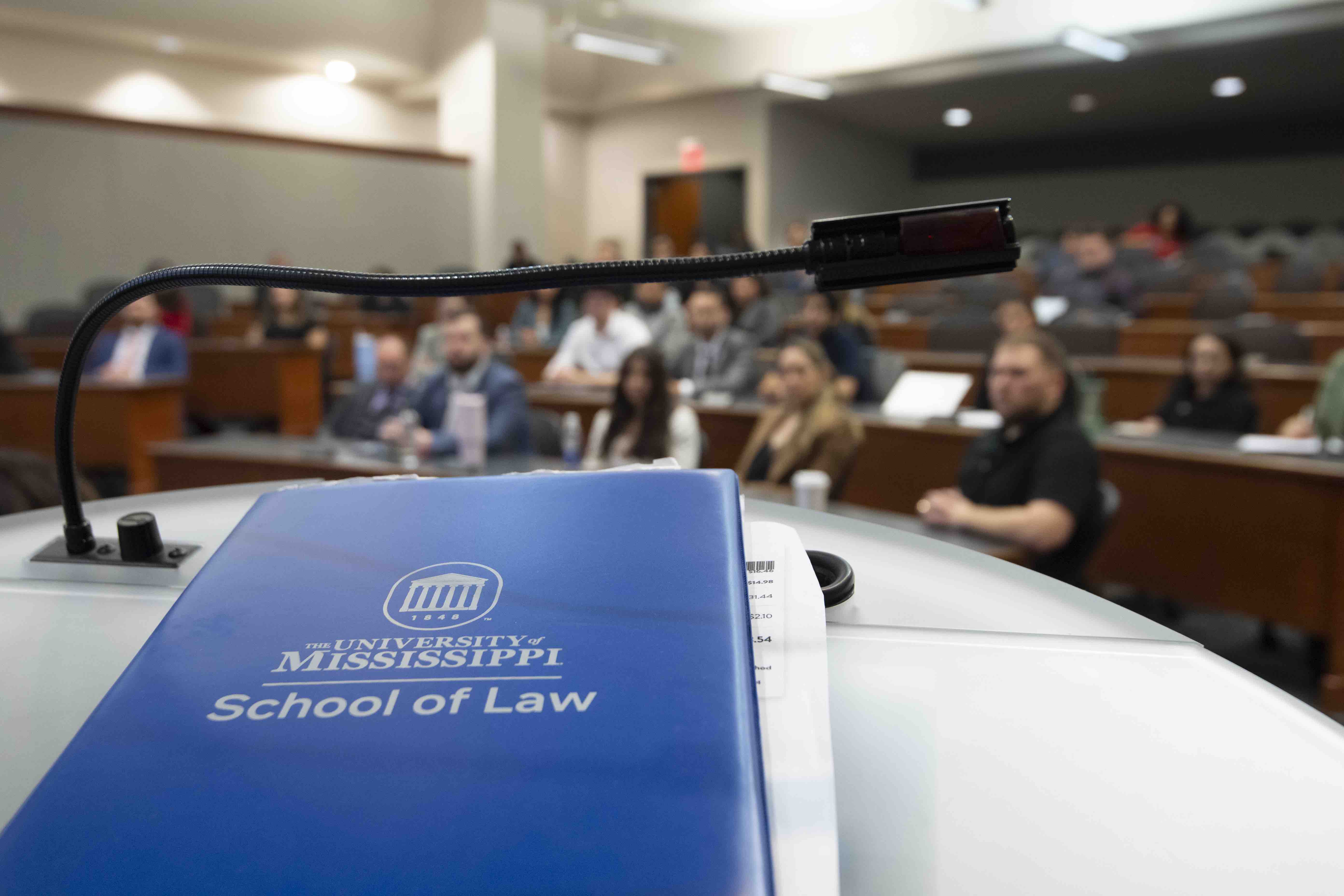
150 Years of Legal Education
A Sesquicentennial History
by Natashia Gregoire

Recognizing the need for formal legal education in the state, in 1854 The University of Mississippi Board of Trustees petitioned the Legislature to establish a “Professorship of Governmental Science and Law,” paving the way for the opening of the UM Department of Law that year.

“The significance of this event in the development of the university, and indeed of the state, cannot be overemphasized,” said Dean Samuel Davis. “The establishment of a Department of Law, with its prestige and influence, elevated the young institution from college status to that of a true university.”
As the fourth-oldest public law school in America, the UM Law School enjoys a distinguished history, said Chancellor Robert Khayat.

“Throughout its 150 years, the school has trained leaders for government service, the judiciary and legal education, as well as the practice of law.”

The Early Days
In 1854, just six years after The University of Mississippi admitted its first students, the Department of Law opened its doors to seven students, all men, who shared a single professor, New Yorker and Holly Springs attorney William F. Stearns.

Those first students studied books donated from the personal collections of Stearns and lawyers on the Board of Trustees. In an early history of the university, alumnus Charles Bowen Howry, an 1867 graduate of the department, said the lawyers on the board of trustees and members of the state bar association were ahead of the general sentiment of the state when they pushed for the creation of a department of law.

Despite criticism from those who thought the state should not participate in the “manufactory of lawyers,” the state Legislature amended the university’s charter to create the department.

Hired to lead a program that covered common law, government, history and international law, Stearns exceeded expectations. He built wide support for the department, especially in the state Legislature. In 1857, lawmakers ruled that a diploma in law from the university entitled holders to a license to practice law. So it remained until November of 1981, when law students were required to pass a bar exam to practice law.

By 1860, the law library had grown from a few donated books to nearly 1,000 volumes. More than 100 students had enrolled in the two-year course and 65 had graduated.

Believing that the department had proved itself, Stearns encouraged the Legislature to amend the university’s charter again to create a second chair of law. Circuit Judge James F. Trotter, a member of the appellate court, was hired to fill the position, but the Civil War forced the closing of the university the following year.

Although Stearns did not oppose secession, the Northerner who had enjoyed great success and the respect of the Legislature was practically exiled.

Following the war, in 1866, Lucius Q.C. Lamar, a politician, soldier and lawyer for whom today’s law center is named, reorganized the department. His influence is still evident.

Citing the inadequacies of the “pure lecture” method of teaching, Lamar introduced students to a method of learning law that required analysis of legal reports—a method of teaching that was later developed at Harvard University into the case system. Lamar scheduled moot court exercises, often presiding as judge.

By the time Lamar left the university in 1870 to return to his law practice, the law department was recognized as an independent unit within the university. The department as shaped by Lamar would remain virtually unchanged for more than a century following his departure. (The law department closed for three years during Reconstruction, from 1874 to 1877, to prevent its relocation to Jackson and its integration.)

When the Democratic Party regained control of state government in 1877, thereby ending the threat of integration, the board reopened the law school. Lamar’s son-in-law Edward Mayes was hired to lead the department. He served for the next 15 years, and during his last two years as chair he also served as chancellor of the university.

Mayes was succeeded in 1892 by professor Albert H. Whitfield, who held the position for two years before resigning to become chief justice of the state Supreme Court. Garvin D. Shands replaced Whitfield and became the first person appointed to the office of dean, a position that was created in 1897. That year, the department reinstated the second chair position, which had been suspended with the closure of 1861.

Growth in the New Century
When Shands resigned in 1905, professor Thomas Somerville was promoted from second chair to dean. Under Somerville’s leadership, in 1911 the law school moved into its own building—Lamar Hall, now known as Ventress Hall—which originally housed the university’s library.

The school enjoyed great success under Dean Leonard Jerome Farley, who succeeded Somerville in 1913. It was Farley who introduced the idea of increasing the law curriculum from two years to three years. Bessie Young, the first female graduate, received her law degree in 1915. And in 1921, the department hired a third professor and formally became a school of law. Farley died that August and was replaced by Dean Thomas C. Kimbrough.

Kimbrough implemented Farley’s plan for a three-year curriculum. With the support of Chancellor Joseph Neely Powers, Kimbrough sought to advance the law school. In 1923, the school gained membership in the Association of American Law Schools. That membership, along with the school’s approval by the American Bar Association, brought the school national recognition as an institution of academic integrity. But the success was short-lived. In 1927, the accrediting agencies placed the law school on probation for poor administration and deficiencies in its library holdings and physical facilities. The school was criticized for lacking basics such as chairs and desks, and faculty for not being “alert or aware of what was being done in legal education elsewhere.”

Kimbrough wasted no time taking his case before the state bar association, which appointed a committee to study the law school. The committee wrote a glowing report. It praised the faculty for doing “splendid work” and “obtaining excellent results” despite working under “handicaps and disadvantages.” That report helped secure $150,000 from the Legislature in 1928 for a new building, equipment and library. With those funds Lamar Hall (now Farley Hall) was constructed and library holdings were increased.

Kimbrough had other significant achievements during his first decade as dean: He introduced a class in legal ethics in 1922 and, in 1928, the law school published its first issue of the Mississippi Law Journal.

continued on page 2

or Back to top