Mind
over Matter
Lynn Parker: To succeed in law
is first to understand people
by Deidra Jackson
Lynn Parker of Gulfport believes successful attorneys
are those most willing to get inside people’s heads. With interests
in arbitration, patent law, mediation and real estate, the second-year
UM law student discovered when she took an elective class — law
and literature — that she wanted to delve deeper into understanding
how other people think. She hopes to parlay her growing insight
into a thriving law career.
“So you understand what drives people to do the things they do,”
said Parker, in describing the course’s purpose in relation to her
core law curriculum. She said she enrolled in the law and literature
class, taught by Judge Michael Mills, to gain better insight into
the human psyche.
Parker said she first became interested in the psyche of lawyers
the summer after her sophomore year at Mississippi State University,
when she worked as a receptionist at Gulfport’s Phelps Dunbar LLP.
She watched attorneys at work and thought, “I could do that.”
The summer job heightened Parker’s interest in the law — one she
always had, she said — so she enrolled in the UM Law School after
graduating summa cum laude from MSU in 2002. An Eastland Scholar,
Parker has done well at UM. She is president of the Black Law Students
Association and this summer interned at a Gulfport insurance defense
firm.
Associate professor Larry Pittman, who has served as BLSA advisor
periodically since 1992, described Parker as “professional and committed.”
“She is a very responsible person who is passionate about her leadership
position,” Pittman said. “She is very confident, very intelligent
and analytical in her approach to problems. It has been a pleasure
working with her as BLSA president.”
Parker counts among her BLSA successes the organization’s 2004 election
protection program, which allowed law students to serve as elections
monitors at polling stations in Lafayette County. She is also pleased
with the high priority BLSA has placed on boosting minority student
recruitment efforts and forming an undergraduate network committee.
“We just recognize that it’s our duty to reach out to minority students,”
she said.
Parker also has reached out to students from other law schools.
Last summer she held a Chicago internship that matched seven law
students from the South with a team of students from DePaul University
College of Law. Working for the volunteer organization AmeriCorps,
the group sought to make contact with people who migrated to Chicago
from the South, primarily African Americans who left the South during
Jim Crow, to let them know of land interests they still held in
their home states.
Besides possessing a keen intelligence and strong leadership skills,
Parker is also regarded as quiet, unassuming and subtle by friends
and colleagues. Such personality traits are effective assets to
carry into the courtroom, said UM assistant law professor Kali Murray.
“She is a deliberate, well-spoken student who brings a different
perspective to intellectual property law issues,” Murray said. “I
really enjoy working with her because to be a good lawyer, you have
to be precise in how you speak and write, and I think Lynn has that
very important quality of precision.”
Parker, whose striking features extend beyond those deemed purely
physical, eschews accolades that are merely skin-deep. She laughs
at suggestions that she should pursue modeling full time, although
she modeled clothes at a Gulfport department store in her youth.
“I don’t like to be the center of attention, but I’m confident with
it,” Parker said. “I’m flattered.” In contrast, embracing the spotlight
is Parker’s brother, John, who recently signed a modeling contract
with a West Hollywood, Calif., agency. Born merely 13 months after
his sister, John Parker described Lynn as “a great role model.”
“Lynn will make a great lawyer,” said John, who graduated from UM
in December 2004 with a marketing degree. “Ever since she was a
little girl she had to be the best at anything she did. She is such
an overachiever, it’s scary. Failure or second place is not in her
mind ... I can’t wait to see the impact that she will make on the
world.”
Although she’s considered low-key, some might be surprised to learn
that Parker has a blue belt and orange belt in Tae Kwon Do and Judo,
respectively. And she counts among her favorite books Cormac McCarthy’s
novel “Child of God,” which she read in her literature and law class.
“It’s a little bit gruesome, because it is about a necrophiliac,
but I liked that it spoke to the human need for acceptance and companionship,”
Parker said. “It also illustrates how we as a society can push ‘undesirable’
people away without stopping to acknowledge their humanity.”
Deidra Jackson is a communications specialist in UM’s Office of Media and Public Relations..
Back to top
Grace Under Pressure
Student brings real world experience,
zeal for life to classroom.
by Mary F. Stanton
Kathryn Wetherbee knows how to work under pressure.
Wetherbee, a first-year law student at the University of Mississippi
experienced a true “trial by fire” when she began working
as a disaster specialist for the American Red Cross just 16 days
before the terrorist attacks on September 11, 2001. A short time
after the attacks, she was sent to New York City.
“The airline fuel — I can still remember the smell,”
Wetherbee said. “First seeing it on television and then being
close up to the debris of the World Trade Center, it’s completely
different.”
Wetherbee worked on Staten Island, where teams searched most of
the debris for clues or remains. “Every day I saw numerous
people who were impacted by the attacks. Every one of them was impacted
directly, everyone knew someone,” she said.
Even with all the trauma Wetherbee has seen, from the fallen towers
to a tornado-damaged city in the South, the sunny 27-year-old said
all of it is a life lesson that made her want to find more ways
to help those in need.
“Katie is one of the most positive people I know,” said
Joyce Whittington, the law school’s director of career services.
She always sees the glass as half full, and that’s the best
outlook to have in the demanding area of law. Katie seems to enjoy
it.”
Assistant law professor Matthew R. Hall agreed. “Katie is
one of the most enthusiastic students I’ ve ever taught,”
Hall said. “She actually gets excited about the details of
the law. She understands when the law is perplexing, funny, ironic,
difficult or wrong.”
Wetherbee’s journey to law school started with an atypical
undergraduate degree, in American Sign Language and deaf studies,
from Maryville College in Maryville, Tenn.
“I had deaf friends growing up and was fascinated by the language,”
she said, “I wanted to know all about it, and Maryville had
a great program.”
Wetherbee said she first wanted to be an activist for the deaf,
but quickly discovered there wasn’t a need for the job.
“It’s hard to be an activist for people who have their
own voice, own hands. You can’t advocate for those who can
advocate for themselves.”
Wetherbee turned to helping disaster victims, working for the Red
Cross, first in Knoxville, Tenn., and then in Jackson as the director
of emergency services. She said that seeing what tornadoes, floods,
and other such natural disasters can do to people’s lives
puts the stress of law school, and the pressures that come with
it, into perspective.
“You see people who’ve lost their homes and are dealing
with the worst of life,” Wetherbee said, “It gives you
perspective. It lets you know that life isn’t about houses
or money or exams. Relationships and people are what it’s
all about.”
Whittington said Wetherbee is always eager to help her law school
classmates. “When the students get their schedules and there’s
a conflict with someone, Katie is the first to switch. She’s
just like that.”
Wetherbee’s friend and law school classmate Amber Griffin
echoed Whittington’s words.
“Katie is definitely always available for an uplifting word
or gesture,” Griffin said. “She brightens my day often
by [helping to] keep me motivated with balancing work and school.”
Even though Wetherbee describes herself as a workaholic, she said
her years with the Red Cross taught her the need for balance between
work and life, especially when the endless cycle of one disaster
after another began to become her life.
“With the Red Cross, I was always on,” she said, “There
are time frames that I remember not by months or years, but by disasters.
Like there was the hurricane, then the tornado, then the flood.”
When Wetherbee started living not from day to day, but from disaster
to disaster, she said she began to notice a change in herself.
“Things stopped becoming emotional and it was beginning to
be just a job,” she said.
To regain her balance, Wetherbee went back to an activity she’s
loved since childhood.
“One of my first memories is of being in the YMCA pool,”
she said. Wetherbee, a certified swimming and lifeguard instructor,
found a summer job instructing over 500 children at Camp Nah-Jee-Wah
in Milton, Penn.
“Working with the kids, you’re always learning, just
being positive and crazy.” And that’s the point for
Wetherbee. Being silly for eight weeks is how she helps maintain
her perspective.
“At camp, you’re just there with the grass. It makes
everything so much fresher.” This year Wetherbee is balancing
the work at Camp Nah-Jee-Wah with a clerking job at International
Paper in Memphis. She said that she’s learned that maintaining
a positive balance in her life takes work.
“It’s about discipline also. I need to study, but I
need to eat, to exercise, to hang out with my friends.”
Fortunately, that was a lesson Wetherbee learned very quickly in
law school.
“In the beginning, Katie seemed to focus solely on law school
instead of giving herself the room she needed to have friends and
develop a social life,” Griffin said. “She was smart
enough to realize that she was not in a good place and turned that
around, enabling her [to have an] outlet to establish that break
between law school and life in general.”
Wetherbee’s balance is paying off. She is among the top 10
percent of her class.
“Law school is a bubble, and coming into it without life experience
can be overwhelming,” Wetherbee said, “But being in
the real world first and then coming to it gives perspective. It
shows that everything is inter-related, like a big puzzle.”
.”
Mary Stanton is the broadcast manager in UM’s Office of Media and Public Relations.
Back to top
On Solid Ground
Naval Academy Grads together Again
at the UM Law School
by Kara Givens
After serving five years in the Navy, Jim and Alyssa
Farrell are enjoying life on dry land and are incorporating their
naval experiences into their legal education.
The first-year law students met 10 years ago in Annapolis, Md.,
during their first day at the U.S. Naval Academy. The academy lined
up the incoming class by last name, and Alyssa Donovan, a Biloxi
native, was near Jim, a native of Tulsa, Okla. The two were dating
by their sophomore year and married shortly after their graduation
in June of 1999.
After leaving Annapolis, Jim and Alyssa were assigned to ships at
Naval Station Pascagoula. The Navy does not allow a married couple
to serve on the same ship, so the two spent much of their first
five years of married life apart even though they were stationed
in the same home port.
“Our ships had different missions, so they also had different
deployment schedules,” Jim said. “I can remember standing
on the bridge of my ship, waving at Alyssa as our ships passed each
other in Pascagoula Channel — one of us returning home and
the other headed back out to sea.”
“You don’t get good at being apart,” Alyssa said.
“We did it because we had to.” Despite the frequent
separation, the two take great pride in their military service and
consider themselves fortunate to have been given the privilege of
leading sailors at sea. The responsibility and dedication they learned
as cadets and then officers have helped make their transfer to law
school enjoyable, they said.
“Alyssa’s background lends a maturity and dedication
to her work that shows up in the classroom on a regular basis,”
said Thomas Clancy, director of UM’s National Center for Justice
and the Rule of Law and Alyssa’s criminal law professor.
When the class was discussing the necessity defense, which permits
someone to violate a criminal law for the greater good, Alyssa pointed
out the Navy’s policy that if a group of sailors on a “swim
call” are in danger of a shark attack, then the first one
bitten may be shot so that the sharks will be drawn to that person
and the others can be saved. This rather gruesome example illustrates
that the modern view of the necessity defense permits the taking
of one life to save others, Clancy said.
Jim’s experience as both a legal officer and a communications
officer has proven beneficial during his time at UM.
“Jim is one of the most organized and focused students I have
taught,” said assistant professor Matthew Hall, Jim’s
property law instructor. “I was particularly impressed by
his written answers to discussion problems during the semester.
Although legal reasoning often reads as mechanical prose, Jim was
able to write with real energy; his analysis was actually pleasant
reading.”
Besides giving them the opportunity to use their expertise gained
in the Navy, law school has provided the couple with a welcomed
opportunity to catch up on lost time.
“Some of our friends joked that we might have trouble getting
used to seeing each other on a daily basis after several years of
moving in different directions,” Jim said. “But we see
this as making up for lost time. It’s better than being in
two different hemispheres.”
In her first two years in the Navy, Alyssa served as the gunnery
officer aboard the USS Yorktown.
She spent much of her time along the coastlines of Colombia, Ecuador
and Panama intercepting drug runners and conducting counter operations.
In her second assignment, Alyssa served as the training officer
for a squadron of eight ships, and much of her work involved diplomacy
and public relations in Latin American countries. Because most Latin
American militaries exclude women, Alyssa often found herself the
sole female representative at conferences and on ships.
Jim spent his first two years as the communications officer aboard
the USS John L. Hall. On his next ship, the USS Ticonderoga, he
began to think about a career in law when his captain made him the
ship’s legal officer and sent him to the Naval Justice School
in Newport, R.I., for training. He also attended the Navy’s
Advanced Gas Turbine Engineering School and ran the ship’s
engineering department.
The year 2001 was the most trying for the two. A week before Sept.
11, Jim’s ship had just returned from a six-month deployment.
Within a few hours of the attacks in New York and Washington, D.C.,
he and Alyssa were both sent back out to sea. Their ships patrolled
the coastal waters from Florida to Texas, intercepting suspicious
vessels and extending U.S. radar coverage into the Gulf of Mexico.
“In the months that followed Sept. 11, I took great pride
in knowing that my service made a difference,” Jim said.
During their time in the Navy, both Alyssa and Jim had many other
unique and rewarding experiences. On the USS John L. Hall, Jim participated
in a five-month NATO operation in northern Europe with ships from
eight other countries. In each country the ships pulled into, Jim
met with his eight NATO counterparts to plan for the next phase
of the operation.
Alyssa’s assignments were enriched by her proficiency in Spanish,
which frequently made her the spokesperson in interviews and community-relations
projects in Latin America.
“The Navy gave me a great opportunity to lead community-relations
projects for schools in Brazil and Ecuador, and I found it to be
a very humble and rewarding experience,” Alyssa said. “We’re
really proud of what we did in the Navy — we both enjoyed
serving our country.”
That enthusiasm for their naval careers has now carried over into
law school.
“We had two very different but equally rewarding experiences,
and our service has given us a much greater appreciation for our
new life as law students,” Jim said.
Back to top
Clerkships
Boost Successful Legal Careers
by Deborah Purnell
When Katherine Pugh Hinkle graduated from the UM
School of Law in December 2002, her main objective was to obtain
a clerkship. “Every Ole Miss law student knows the importance
of clerking,” said Hinkle, a Louisiana native. “While
the big clerkships, at the federal courts and state supreme courts,
are highly sought after because of the great pay, the smaller clerkships
can provide invaluable experience in the inner workings of the court
system.”
Before clerking for a year and a half at the Mississippi Court of
Appeals for Judge Billy B. Bridges after graduating, Hinkle clerked
with Judge W. Swan Yerger after her second year of law school. She
recently completed a clerkship in the Circuit Court of Hinds County
with Yerger and Judge Bobby B. DeLaughter, who as an assistant district
attorney successfully prosecuted Byron De La Beckwith for the murder
of civil rights activist Medgar Evers.
“I was fortunate to work with a judge with a long history
of judicial experience (Yerger) and one with a long (history of)
criminal experience (DeLaughter),” Hinkle said. “The
opportunity to work with DeLaughter was unique and rewarding. It
only served to reinforce my desire to work in the (Hinds County)
District Attorney’s Office.”
Employed as an assistant district attorney in Hinds County since
May, Hinkle said she would definitely recommend clerking to law
students. She said the most important lesson she’s learned
from clerking is the necessity of being prepared.
“Nothing is worse than a poor argument or stumbling questioning
or a poorly written brief. (Being) prepared is a must, and I experienced
this at the appellate and trial level.”
Hinkle said clerkships also provide an excellent opportunity to
interact with local attorneys and evaluate future employment and
career interests.
“Initially, my primary interest in law school centered on
family law,” she said. “It wasn’t until I started
clerking at the Court of Appeals, where a majority of the work revolved
around criminal law, that I began to develop a genuine interest
for the criminal aspect of the law. This potential avenue was reinforced
by my clerking experience at the circuit court level.”
A 2000 graduate of the Ole Miss School of Business, Hinkle and her
husband John (JD ‘01) reside in Madison.”
Deborah Purnell is a communications specialist in UM’s Office of Media and Public Relations.
Students at Work: Judicial Law
Clerks — Class of 2004
Tamaca LaShell Brown
Judge Tyree Irving Mississippi Court of Appeals Jackson, Miss.
Anna Christian Gibson
Judge T. Kenneth Griffis Mississippi Court of Appeals Jackson, Miss.
John Timothy Givens
Judge Donna M. Barnes Mississippi Court of Appeals Jackson, Miss.
Jennifer Leigh Hawks
Justice Jess H. Dickinson Supreme Court of Mississippi Jackson,
Miss.
Joseph Maddrey
Long Judge Joseph H. Loper Fifth Circuit Court District Ackerman,
Miss.
Warren Louis Martin Jr.
Justice James E. Graves Jr. Supreme Court of Mississippi Jackson,
Miss.
Michael Clark McCabe Jr.
Judge John M. Roper United States Magistrate Court Biloxi, Miss.
Brett Francis McCall
Judge David M. Ishee Mississippi Court of Appeals Jackson, Miss.
Caroline M. Meng
Justice Michael K. Randolph Supreme Court of Mississippi Jackson,
Miss.
Bradley C. Moody
Judge David C. Bramlette III United States District Court Southern
District of Mississippi Biloxi, Miss.
Joshua L. Rogers
Presiding Justice William L. Waller Jr. Supreme Court of Mississippi
Jackson, Miss.
Brian Carter Smith
Judge Rhesa H. Barksdale Fifth Circuit Court of Appeals Jackson,
Miss.
James B. Smith
Chelan County Superior Court Wenatchee, Wash.
Charles W. Summers III
Judge George C. Carlson Jr. Supreme Court of Mississippi Jackson,
Miss.
Robert Benjamin Weir II
Executive Office for Immigration Review Immigration Court Oakdale,
La.
Anthony P. Zana
Senior Judge James H. Hancock United States District Court Northern
District of Alabama Birmingham, Ala.
Back
to top
Building Blocks
Engineer finds success in law school
by Angela Moore
Two years ago, John D. Mayo, a 1998 graduate of the
Ole Miss School of Engineering, was just hitting his stride as a
project manger for Willmer Engineering in Atlanta.
He got up at dawn every day and made it to the job site by 7:30
a.m., supervising crews as they drilled 200 feet below Atlanta to
modernize the city’s storm water and sewer system or as they designed
new runways at the nation’s busiest airport as part of a $5-billion
construction project.
He was a young engineer on the rise in a lucrative, stable profession.
And he desperately wanted to do something else.
“The people I worked with and my employers were wonderful, and I
really enjoyed the work,” Mayo said. “But I didn’t think that I
would be happy just doing that for the rest of my life.”
Mayo toyed with earning a master’s degree in business administration,
but ultimately decided to stick with family tradition: his brother,
Cal, and father, James, are both lawyers who graduated from the
University of Virginia and the University of Mississippi School
of Law, respectively. Cal is a partner in Mayo Mallette in Oxford;
James is a partner in Fair and Mayo in Louisville.
So Mayo jumped off the track towards running his own engineering
firm and headed towards a future with his own law firm. Mayo moved
back to Oxford as a student in August 2003.
“It was a huge adjustment,” said Mayo, who was accustomed to spending
his days outside in the field, not hunched over a law book. “In
the beginning, I had to really concentrate on being back in the
classroom.”
The secret, Mayo found, was treating law school like his job. He
still gets up at the crack of dawn this time, to study and then
studies after class. Quitting time is early evening. Exams work
the same way.
“With big engineering projects, there’s always a deadline,” Mayo
said. “Now, the deadline is exams at the end of the semester.”
The system has worked for Mayo: he’s earned a 3.4 GPA and membership
into Phi Delta Phi legal fraternity.
Mayo’s also found that his undergraduate education, which emphasized
analytical reasoning and logic, has served him better in law school
than a degree in history or English might have.
“Law uses the same analytical thought process that engineering does,”
Mayo said. “Others without that may see an issue as right or wrong,
but engineers can’t be emotional at all. It probably makes it easier
for me to look at things from a third-person type view, without
getting caught up in the emotions of a lawsuit.”
Last summer, he tested his legal knowledge while clerking at two
firms in Birmingham, Ala. Mayo worked on construction law cases
at Bradley Arant Rose & White, and construction law and product
liability cases at Lightfoot Franklin & White.
Although construction law would seem to be his area of expertise,
given his years performing geotechnical investigations for major
construction projects, Mayo also finds himself drawn to product
liability, which he said involved science and engineering on a more
basic level.
“You have to be able to read these very technical reports and determine
what’s at fault in an accident,” Mayo said. Because he understood
the scientific principles, the work was fun for him.
UM Engineering professor Greg Easson, Mayo’s favorite geological
engineering professor, said he isn’t surprised Mayo decided to give
law school a whirl.
“He was one of those guys that, even with all the rigors of an engineering
degree, found a way to be involved in a lot of different things,”
said Easson, the director UM’s Geoinformatics Center, which applies
remote sensing technologies to earth-bound problems.
While it’s not uncommon for UM School of Engineering graduates to
enter law school immediately after graduation, it is very unusual
for an engineer to give up a promising career like Mayo’s to start
over, though perhaps more should, Easson said. “I’ve only known
three engineers who have done that, counting John,” Easson said.
“Truthfully, environmental law and construction law need more engineers.
Too many lawyers go into that with backgrounds in political science.
John’s background in geology and hydrology is a real advantage to
him.”
This summer, Mayo is continuing his clerkships at the construction
law and product liability firms in Birmingham, this time with greater
responsibilities and a little more expertise on the law aspects
of the job. He’s got the science side covered.
“Engineers are the most important people in the world because they
fix things,” Easson joked. “Maybe John will be a lawyer who will
actually fix things.””
Angela Moore is a communications specialist in
UM’s Office of Media and Public Relations.
She covers the School of Engineering.
Back to top

Drenched
Graduates receive diplomas, advice during rain-soaked ceremony
By Natashia Gregoire
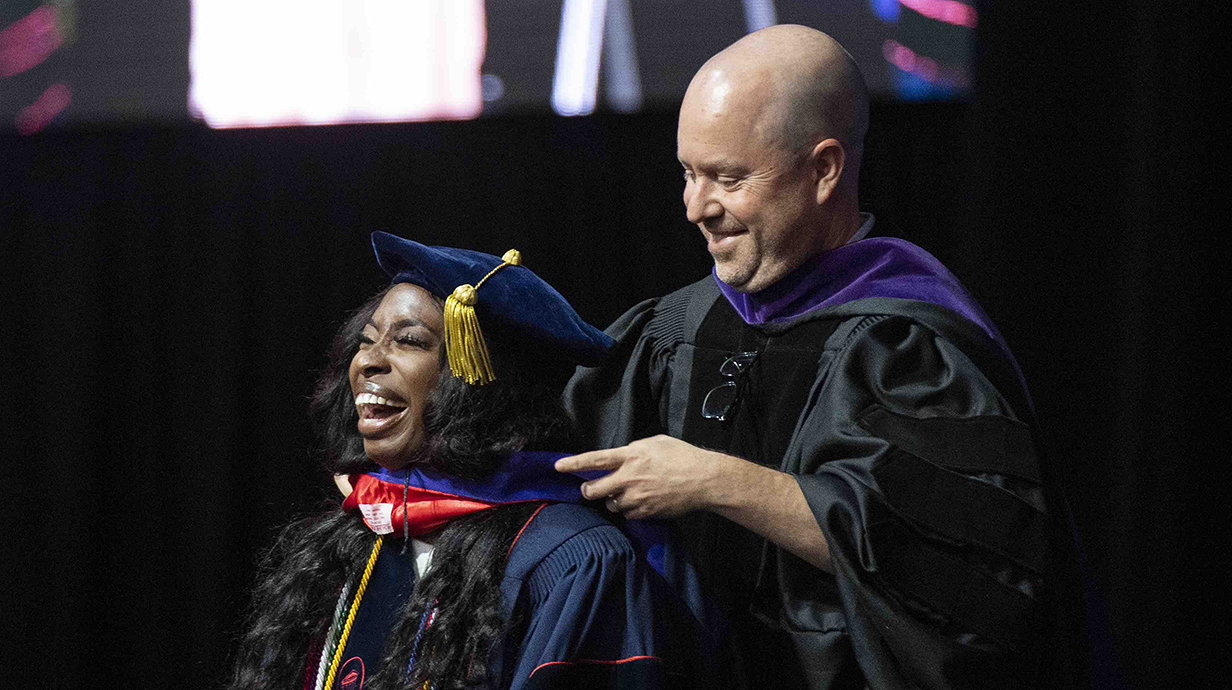
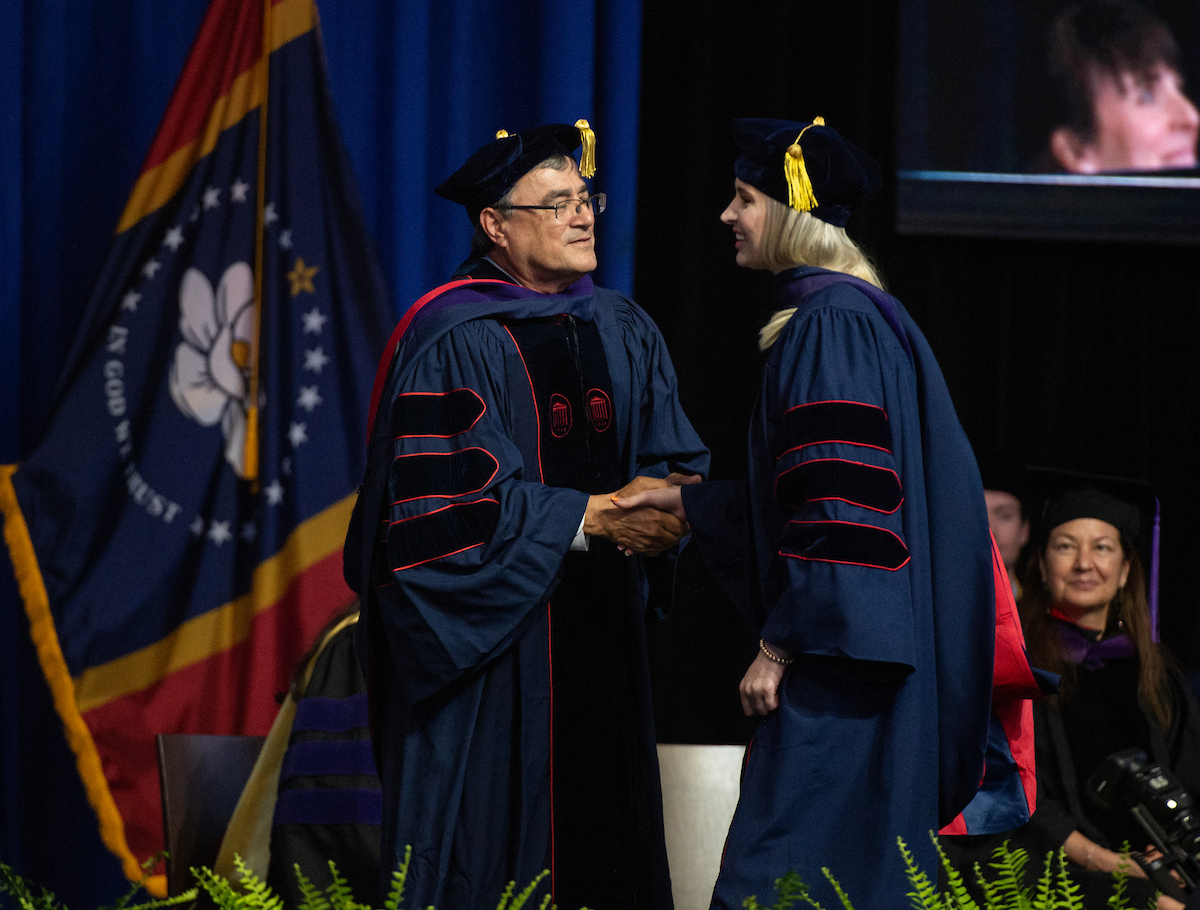
Torrential rain, thunder and lightning did not stop the graduating
class of 2005 from receiving their diplomas May 14. All 201 graduates
and their loved ones braved the Saturday storm for the UM Law School’s
sesquicentennial commencement ceremony.
“I think this front stretches from here to Utah,” Dean Samuel Davis
said, preparing the class for the rainy proceedings.
Despite the weather, the ceremony went on as planned. The graduates
paid tribute to classmate Josh Ousley, who died in 2003 after a
battle with cystic fibrosis. And class president, Michael Shane
Painter, led his classmates down memory lane with anecdotes of late-night
study sessions and parties.
Keeping
with tradition, the president of the Mississippi Bar delivered the
keynote address. President Charles Swayze (JD 69) of Greenwood advised
the class to work long hours to achieve success.
“Competition to enter law school was keen, and you have found that
competition for performance, achievement and grades in law school
has been equally as keen,” Swayze said. “I urge you to prepare for
this competition to accelerate as you begin to practice law.”
Swayze encouraged the class to look among themselves for future
legislators, judges, governors and deans.
“I know that from my class experience,” said Swayze, who graduated
from the UM Law School with Davis.
As he welcomed them to the legal profession, Swayze encouraged the
graduates to uphold the dignity of the profession.
“My advice is to develop a strong professional value system and
let it control your conduct as you practice law,” he said.
“It’s time to remove the myths. It’s time to speak up on behalf
of a caring profession which protects the rights of all citizens.
We are not hired guns. We are members of a profession with high
standards of conduct and character.”
As
the Mississippi Bar celebrates its centennial, Swayze has been leading
the charge on two initiatives. Along with the Mississippi Supreme
Court, the bar association has been working to create a set of uniform
civil practice rules for all local courts. The group is also working
to review the efficiency and procedures of the Mississippi Judicial
Performance Commission.
Swayze, a former U.S. Army captain, has been practicing law in Greenwood
since 1973, the year he received his master of laws degree from
George Washington University. He practices in the areas of litigation,
mediation and arbitration.
Swayze, who turned 61 on graduation day, was accompanied by his
wife, Jo Claire Swayze, a member of the Greenwood City Council.
They are the parents of four children, Julie, Allison, Melissa and
Charlie.
Swayze dismissed the graduates with a challenge. “You all have a
clean slate and a bright future ahead. Go forward from this graduation
and write a career story that will make you and your family proud.”
Back to top
2005
Law Awards Recipients


WILLIAM WALLER CRIMINAL LAW AWARD
Presented annually to the students demonstrating outstanding ability
in the field of criminal procedure: Spring 2004 — Elise
M. Kochtitzky
Fall 2004 — Hallie E. Bourland
WILLIAM W. GATES MEMORIAL SCHOLARSHIP IN LAW
Established in 2002 by family and friends to honor the memory of William
W. Gates, a May 2002 graduate of the law school, who died Oct. 17,
2002:
Laura L. Hill
MISSISSIPPI BAR FOUNDATION SCHOLARSHIP
Presented annually to the student who has demonstrated academic achievement
and service:
Jennifer B. Kimble
MISSISSIPPI BAR BUSINESS LAW SECTION AWARD
Presented annually to the second-year law student with an
aptitude and interest in business law:
Hallie E. Bourland
MISSISSIPPI BAR LITIGATION/ GENERAL PRACTICE SECTION AWARD
Presented annually to two outstanding students in the Trial
Practice classes:
Kenya R. Martin
Colleen M. Sweeney
MISSISSIPPI BAR FAMILY LAW SECTION AWARD
Presented annually to two students excelling in the area
of family law:
Dana A. “Doc” Gearhart
Joan L. Lucas
MISSISSIPPI BAR ESTATES AND TRUSTS SECTION AWARD
Presented for the first time this year to a student excelling
in the area of estates and trusts:
Mitchell D. Thweatt
AMERICAN BOARD OF TRIAL ADVOCATES FOUNDATION PROFESSIONAL LEADERSHIP
AWARD
Established in January 2002 by a gift from Butler, Snow,
O’Mara, Stevens and Cannada, PLLC, in honor of 2001 ABOTA President
W. Scott Welch III. Presented to a third-year law student who best
exemplifies and demonstrates the attributes of a leader in the legal
profession:
Michael Shane Painter
JUDGE NEAL B. BIGGERS JR. CONSTITUTIONAL LAW AWARD
Presented to recognize the Hon. Neal B. Biggers Jr., senior
judge of the United States District Court for the Northern District
of Mississippi. Established by the attorneys of the Northern District
Bar to honor Judge Biggers and awarded to the three students making
the highest grade in the Constitutional Law classes:
Hallie E. Bourland
Edgar Hyde Carby
Paul B. Watkins
CHARLES NUNNALLY DEAN MEMORIAL AWARD
Presented annually to the students having the highest grade
in the Secured Transactions classes. Established by Charles Dean’s
great friend Grady F. Tollison Jr. to honor his memory.
Laura Dyer Elkins
Robin E. Samson
DEAN’S DISTINGUISHED SERVICE AWARD
Presented annually by the Law Alumni Chapter of the University
of Mississippi Alumni Association to the senior law students who have,
in the opinion of the Law School Student Body Senate, distinguished
themselves during their law school careers in service to the student
body, faculty and staff:
Christyn L. Baldwin
Jennifer B. Kimble
Michael Shane Painter
HARRY L. CASE JR. MEMORIAL AWARD
Presented annually to the student demonstrating outstanding
ability in the field of corporations law:
Michael J. Holley
W. KERBY BOWLING SR. MEMORIAL LABOR AWARD
Established by W. Kerby Bowling Sr. in 1969 for the student
who shows the greatest promise in the field of labor law. Following
Mr. Bowling’s death in 1996, the law firm Bowling, Bowling and
Associates has continued the award in his memory:
Alexandra L. Hutton
WRIGHT LAW FIRM FAMILY LAW AWARD
Presented by the Wright Law Firm of Jackson to the law student
demonstrating an unusual aptitude for family law:
LaDonna Curtis
THE DARWIN A. HARROLD MEMORIAL IMMIGRATION LAW AWARD
Recently established by the Harrold family to honor the memory
of Darwin A. Harrold. Presented to the student who shows the greatest
promise in the field of immigration law:
Robert E. Kelly
FRANCIS S. BOWLING SCHOLARSHIP IN LAW
Established by Jackson attorney James P. Cothren and his
wife, Pat, to honor the late Mississippi Supreme Court Justice Francis
S. Bowling. Presented annually to the student who wins the Fall Moot
Court Competition:
Tiffany A. Berg
CAMPBELL DELONG, LLP SCHOLARSHIP IN LAW
Established in 2002 by the law firm of Campbell DeLong, LLP,
of Greenville. Presented annually to the student who wins the Spring
Moot Court Competition:
Brandon L. Flechas
THE ORDER OF BARRISTER
A national honorary organization that recognizes graduating
law students who have excelled in moot court and mock trial activities.
Members from the 2004 graduating class:
Stephanie A. Case
Emily E. Cox
Clayton A. Dabbs
Sabrina A. Davidson
Brian O. Lucas
Robert D. Schultze
Christopher J. Steiskal
Sarah N. Tinkler
STEEN REYNOLDS AND DALEHITE NATIONAL TRIAL COMPETITION TEAM AWARD
Established in 1981 by the former law firm of Steen Reynolds
and Dalehite in an effort to enhance the trial advocacy training program:
Kevin W. Frye
James B. Justice
STEEN REYNOLDS AND DALEHITE NATIONAL TRIAL COMPETITION TEAM AWARD
For the first time in law school history, a second team was
sent to the National Trial Competition:
Frankie A. Glennis
Russell Latino III
Edricke L. Peyton
THE 2005 ABA REPRESENTATION IN MEDIATION COMPETITION TEAM AWARD
This is the third year the law school has participated in
this competition, which was held at the law school for the first time
in March:
Clinton E. Frazier
Douglas B. Hargett
William Bradley Palmertree
Darrell C. TuckerMLDA/REGINALD GRAY SCHOLARSHIP
Presented annually by the Mississippi Defense Lawyers Association
to two second-year law students who have demonstrated academic ability
and motivation for civil defense trial practice:
David P. Curtis
Edward J. Everitt
AMSOUTH BANK TRUST AWARD
Presented this year by AmSouth Bank to the student having
the highest grade in the area of estate and gift tax:
Mitchell D. Thweatt
TRUSTMARK NATIONAL BANK AWARD
Presented this year by Trustmark National Bank to the student
having the highest grade in the area of wills and estates:
Brandon L. Jolly
DEAN ROBERT J. FARLEY AWARD
Presented to the student graduating with the highest academic average:
Amanda Robinson Poe
FREDERICK P. HAMEL MEMORIAL AWARD
Presented annually by McComb attorney Norman B. Gillis Jr.
to honor the memory of his classmate Frederick P. Hamel. Presented
to the student having the highest scholastic average in the first-year
class:
Paul B. Watkins
PHI DELTA PHI AWARD
Presented by Phi Delta Phi to the senior whose character,
scholarship, personality and general ability, in the opinion of the
law faculty, best exemplify the attributes of a successful lawyer:
Robin E. Samson
PATRICK MICHAEL MAGANN PUBLIC INTEREST AWARD
Presented annually to the law students who have worked tirelessly
for the law school’s Public Interest Law Clinic:
Elizabeth R. Penn
Erin E. Pridgen
PAT D. HOLCOMB MEMORIAL AWARD FOR EXCELLENCE
Presented annually by the law firm of Holcomb Dunbar to the
outstanding first-year law student as selected by the faculty who
teach first-year law students:
Paul B. Watkins
MISSISSIPPI TRIAL LAWYERS ASSOCIATION FRANCIS S. BOWLING SCHOLARSHIP
IN LAW
Presented annually by the Mississippi Trial Lawyers Association
to the student who has demonstrated academic ability, leadership ability
and trial advocacy skills:
Casey Langston Lott
ROBERT C. KHAYAT SCHOLARSHIP
Presented to the Mississippi Law Journal member who exemplifies
attributes similar to those of the honoree. This award is funded by
the Robert C. Khayat Scholarship Endowment:
Darrell C. Tucker
BAKER, DONELSON, BEARMAN, CALDWELL & BERKOWITZ, PC, MISSISSIPPI
LAW JOURNAL AWARD
Presented by the law firm of Baker, Donelson, Bearman, Caldwell
& Berkowitz to recognize the member of the Mississippi Law Journal
for exemplary legal research and writing of the outstanding comment
for the fall 2004 semester:
Erin V. Everett
HEILMAN KENNEDY GRAHAM, P.A., MISSISSIPPI LAW JOURNAL AWARD
Presented annually to the member of the Mississippi Law Journal
who writes the most outstanding comment:
Edward J. Everitt
WILLIAM CHAMPION CIVIL PROCEDURE AWARD
Established by Jackson attorney Sam E. Scott and his wife,
Carol, to honor professor William M. Champion, this award is now funded
by the McGlinchey Stafford Foundation. Presented annually to the students
excelling in the field of Civil Procedure II:
Jesse T. Hercules
Rhoda A. Holman
Robert G. Mayer
MISSISSIPPI BANKRUPTCY CONFERENCE, INC., SCHOLARSHIP
Presented annually by the Mississippi Bankruptcy Conference,
Inc., to the student making the highest grade in the bankruptcy-related
class:
Rhoda L. Holman
MARTHA WILSON GERALD MWLA SCHOLARSHIP
Presented to the third-year female student with the highest
grade-point average in the graduating class to honor the memory of
the late Martha Wilson Gerald, an attorney in Jackson:
Elise M. Kochtitzky
THE UNIVERSITY OF MISSISSIPPI MOOT COURT BOARD APPELLATE ADVOCACY
COMPETITION AWARDS
Presented to the winner and runner-up of the Oral Appellate
Argument competition for each semester:
Fall 2004 Winner — Tiffany A. Berg
Runner-up — Steven W. King
Spring 2005 Winner — Brandon L. Flechas
Runner-up — Latoya D. Funchess
The following students were recognized for outstanding brief writing:
Fall 2004 — Dam P. Taylor
Spring 2005 — Paul T. Beckmann
THE UNIVERSITY OF MISSISSIPPI MOOT COURT BOARD TRIAL ADVOCACY COMPETITION
AWARDS
Presented for the first time this year by the board to the
winners and runners-up of the Spring 2005 Trial Advocacy Competition:
Winning Team:
Laura A. Hill
Elizabeth H. Hoffman
Second-Place Team Members: Brandon L. Flechas
Joshua P. Fortenberry
THE UNIVERSITY OF MISSISSIPPI MOOT COURT BOARD MEMBER OF THE YEAR
Presented for the fall and spring semesters to two Moot Court
Board members for their outstanding service to the board. The selection
is made by a vote of the full board membership:
Fall 2004 — Jamilla C. Espy
Spring 2005 — Steven W. King
THE NATIONAL FIRST AMENDMENT LAW MOOT COURT COMPETITION TEAM AWARD
This is the fourth time students have competed in this competition
that was held at Vanderbilt University and at the Freedom Forum First
Amendment Center in Nashville in late February:
H. Barber Boone
A. Meaghin Burke
FREDERICK B. DOUGLASS MOOT COURT COMPETITION TEAM AWARD
Presented annually to the members of the Frederick B. Douglass
Moot Court Competition Team, coached by Professor Larry Pittman:
Latoya K. Tate
Sumeka C. Thomas
Edricke E. Peyton
Latoya M. Reed
PHILLIP C. JESSUP INTERNATIONAL LAW MOOT COURT COMPETITION TEAM AWARD
Presented annually to the members of the Philip C. Jessup
International Law Moot Court Competition Team:
Michael S. Carr
Nicholas B. Holtz
Robert E. Kelly
Jamie G. Rutland
Thomas M. Taff
THE STEPHEN GOROVE-MYRES S. MCDOUGAL SPACE LAW AWARD
This award has been reborn with the return of The Journal
of Space Law to the law school. Established by a gift from Art Dula
of Houston, Texas. Presented in honor of the contributions made by
the late Dr. Stephen Gorove, founder of the journal, to students who
have distinguished themselves in the field of space law and/or working
on the journal:
Tracy K. Bowles
Robert E. Kelly
Lori Moorman
ROBERT W. UPCHURCH AWARD
Funded by the Mississippi Chapter of the Federal Bar Association.
Presented annually to the students demonstrating excellence in the
field of federal jurisdiction:
Jennifer B. Kimble
Paul G. ShermanNote: This list includes scholarships and awards
presented that are not covered elsewhere in this publication. Scholarships
and awards presented in the spring semester are highlighted in this
issue of UM Lawyer. Those given in the fall semester will be featured
in the fall magazine.
Back to top
|