| Celebrating
Diversity
Law lecture series addresses diversity in legal
education
by Natashia Gregoire
As part of its sesquicentennial observance, the UM
Law School examined the role of diversity in legal education. Three
leaders in the area visited UM during the spring semester as part
of the Diversity and the Future of Legal Education lecture series.
Law professor and civil rights scholar Roy L. Brooks opened the
series Feb. 3 with his lecture “The Obligations of State Institutions
of Higher Education in the Aftermath of Racial Atrocities.”
“The theme of diversity in legal education is an important
one today because, in light of the Supreme Court’s decisions
last term in the University of Michigan cases, many law schools
are struggling with how to maintain commitment to the goal of diversity
consistently with the guidelines furnished by the Supreme Court,”
said Samuel Davis, dean of the UM Law School.
Other speakers in the series included Frank H. Wu, dean of Wayne
State University Law School, who delivered the March 23 Matthews
Lecture in Law, “Diversity in the New World: The Future of
Education.” On March 31, Peter Black, professor of law at
the University of Iowa, presented “Americans with Disabilities
and their Civil Rights.”
“The speakers in this lecture series are some of the most
outstanding and influential people in the country on the subjects
of civil rights, human rights and diversity,” Davis said.
“We enjoyed hosting them.”
The idea for a lecture series on diversity issues was conceived
by professors Michael Hoffheimer and Michael Waterstone.
Atonement, Not Reparations,
Can Heal Racial Wounds
Civic institutions and private corporations are starting
to hold themselves accountable for slavery and Jim Crow, but more
atonement is needed so black Americans can begin to see a level
playing field, said law professor and civil rights scholar Roy L.
Brooks. Brooks made the comments during his Feb. 3 lecture at the
UM Law School, the first talk in the Diversity and the Future of
Legal Education lecture series.
In his lecture, “The Obligations of State Institutions of
Higher Education in the Aftermath of Racial Atrocities,” held
in the law school’s William N. Ethridge Jr. Moot Court Room,
Brooks highlighted several instances of corporate and
educational institutions that are making amends for their roles
in the oppression
of blacks in America.
“What we are experiencing today is quite extraordinary,”
Brooks said. “This may be the most significant development
since the end of civil rights.”
Brooks discussed recent examples of atonement taking place in corporate
America and academia. Such companies as Etna and JP Morgan Chase,
which both acknowledged its predecessors accepted slaves as collateral
for loans, have issued apologies.
In 2000 Chicago Mayor Richard Daily apologized publicly to black
Americans in the city for slavery. In higher education, the University
of Alabama apologized for slavery, and Brown University is going
through a self study to discover any role it may have played.
These admissions have led to lawsuits against some of the institutions,
but Brooks said lawsuits are not the answer. He advocates an atonement
model of racial reconciliation instead of a torts model.
“Lawsuits against atoning companies are misguided,”
Brooks said. “They are confrontational rather than conciliatory.
Institutional atonement is a complex matrix of guilt and humility
… it raises the moral threshold of our society.”
Brooks is the Warren Distinguished Professor of Law at the University
of San Diego, where he teaches and writes in the areas of civil
procedure, civil rights, employment discrimination and critical
theory. He is author of more than a dozen books, including “Integration
or Separation? A Strategy for Racial Equality” and “Rethinking
the American Race Problem,” both of which received National
Book Awards. His book “When Sorry Isn’t Enough: The
Controversy Over Apologies and Reparations for Human Injustice”
received the 2000 Thorsnes Prize in Scholarship.
“Roy Brooks is one of the foremost legal experts in terms
of race relations and reparations,” said UM civil rights law
professor Michael Waterstone. “He really is one of the leading
national voices on race and the law. At a time when the state and
university stand poised to be leaders on this issue, we are pleased
to have someone of his stature join us in kicking off (the diversity
lecture) series.”
“Racial reconciliation is the only way to step up and finish
the job started by Martin Luther King Jr. and other civil rights
leaders,” Brooks said, challenging the government to get involved.
“This is not a job that can be outsourced.”
Brooks: Colleges, UM Must Make Amends
The racist ideology that was developed to justify
slavery has outlived the institution of slavery, thus atonement
is necessary, Brooks said. Unlike litigation, which looks backward
and focuses on the victim, atonement is a forward-looking method
that facilitates truth seeking.
To further explain his atonement model, Brooks addressed the question:
“What can Ole Miss and other civil institutions do to atone
for slavery and Jim Crow?”
“Proceeding under the atonement model, Ole Miss should issue
an apology and solidify the apology with reparations,” Brooks
said. He said the university should publicly admit an injustice
was committed, repent and request forgiveness.
“To say I’m sorry is not enough,” Brooks said.
The university must offer reparations. “The reparations should
be rehabilitation instead of compensatory. It should be aimed at
groups affected, not individuals seeking money.”
Brooks offered several examples of rehabilitation-based reparations
that UM and other universities could offer to atone for the past:
• Erect a memorial honoring the slaves who lived in the state
and labored to build the university.
• Set up an atonement scholarship fund for descendants of
slaves who are connected to the state.
• Award scholarships to black students on the basis of financial
means.
• Implement an African American atonement admissions program
requiring students to serve the state’s black communities
for a fixed number of years after graduation.
• Create an atonement grant for professors who focus their
research on the effects of slavery.
“We can’t move on to a colorblind society until we acknowledge
the racial faultline,” Brooks said. “We have to look
to the past if we are going to look toward the future.”
“Roy Brooks is outstanding in his own right,” said Dean
Samuel Davis. “What he had to say was thought-provoking and
challenging.”
Natashia Gregoire is the editor of UM Lawyer Magazine. She
is a communications specialist and journalism instructor at the
University of Mississippi.
Race
Debate Will Never End
by Kara Givens
Frank Wu, dean of Wayne State University Law School,
delivered a powerful message on race, diversity and the role of
democracy by providing examples from his own experiences with racial
profiling.
With his March 23 address, Wu became the law school’s 17th
Matthews Lecturer in Law and the second speaker in the Diversity
and the Future of Legal Education series.
He began his lecture, “Diversity in the New World: The Future
of Legal Education,” by using two personal stories to provoke
the audience to think about race.
One anecdote involved young boys striking a martial arts stance
when they passed him on the street, assuming that his Asian heritage
meant he was the stereotypical Asian male seen on TV and in movies.
“If that bothers me, then I have a responsibility to care
when the situation is very different,” Wu said.
His second example involved his walking down a dark street alone
at night and crossing the street when he realized there was a young
black man behind him.
“There is something wrong here,” Wu said. “Without
having said a word, I’ve conveyed to him, for nothing more
than his color, my feelings.”
The answer to resolving those feelings does not come from debates
about affirmative action, decision making and race, because in the
end, the debate is a form of entertainment and is not meant to change
people’s minds, Wu said.
“When we debate affirmative action, we focus on the remedy
and not the original problem,” Wu said. “We need dialogue
that leads to action and public policy. To start with, affirmative
action is to do everything backwards.”
Wu said he sees no end to discussions about race and equality.
“Diversity is like democracy, a process, not an outcome,”
he said. “The goal of a democracy is to participate in it
as equals, to invite others in.”
Law professor Michael Hoffheimer agrees with Wu on the issue of
diversity.
“There’s no topic that is more important to the future
of legal education,” Hoffheimer said.
Wu said that the country’s racial profile is changing from
a white majority to many minorities, and it is predicted that within
the next several decades there will be no single majority race.
He pointed to places like California as an example and explained
that this changed demography will force the nation to look at its
beliefs in a new way.
“The question then becomes whether we are a nation of believers
in genuine equality (as) found in the Constitution and Fourteenth
Amendment,” Wu said.
Wu cited Dr. Martin Luther King Jr. as a man who lived up to his
beliefs about America’s basic freedoms for all.
“The challenge for us is not how to change principles but
how to live up to them,” Wu said. “Dr. King loved our
nation and treated people with respect as honest and decent but
challenged them to live up to their words.”
First-year law student Maggie Maynord from Vicksburg said she agreed
with everything Wu said.
“This issue should be more in our face, especially in Mississippi.
His point about subtle discrimination is something we need to be
more aware of.”
Wu is the author of “Yellow: Race in America Beyond Black
and White” and co-author of “Race, Rights and Reparation:
Law and the Japanese American Internment.” He spent 10 years
as a law professor at Howard University before joining Wayne State
University Law School as dean in 2004.
“We as lawyers ought to embrace diverse solutions as best
we can and raise the standards,” Wu said.
The Matthews Lecture series honors U.S. District Court Judge Burnita
Shelton Matthews, a native Mississippian and the first woman to
serve in the United States as a federal district judge.
“We are honored to have a person of Dr. Wu’s stature
here,” said Samuel Davis, dean of the law school. “He
is an outstanding speaker.”
Disability
is Diversity
by Natashia Gregoire
Disability is a fitting topic for a diversity lecture
series said disability law expert Peter Blanck during a March lecture
at the UM Law School.
“There are strong parallels between race and gender discrimination
and disability discrimination,” said Blanck, the Charles M.
and Marion Kierscht Professor of Law at the University of Iowa.
He is so respected in his field that Blanck has been commissioned
to write the 15-year progress report on the Americans with Disabilities
Act. Passed in 1990, the ADA prohibits private employers, state
and local governments, employment agencies and labor unions from
discriminating against qualified individuals with disabilities.
Blanck acknowledged that the ADA is not a perfect law, but rejected
criticism that it is a “misguided act.” Despite its
flaws, the ADA is becoming a worldwide model, Blanck said.
“There is no doubting that our society is more accessible
today than it was 10 years ago,” Blanck said. He added that
he’s seen changes in attitudes about disability, which proves
the ADA is having a positive impact.
“Peter is a real giant nationally and internationally in the
area of disability studies,” said UM law professor Michael
Waterstone, who introduced Blanck to a packed moot court room.

Blanck’s hour-long lecture addressed the basic goals that
people with disabilities are seeking to accomplish. Among those
are equal rights, inclusion, economic empowerment and the right
to live in a free and appropriate setting.
“These are really personal issues,” Blanck said. “It’s
the personal stories that define you and define the disability movement.”
Blanck, a highly sought litigator, said he has enough cases to last
100 years, but contrary to conventional wisdom, those cases are
not primarily about physical access to buildings or public places.
They are about “basic attitudes to people with disabilities
as unworthy of the protection that we might normally afford to every
citizen,” Blanck said.
Blanck highlighted several cases to demonstrate the courts’
attitudes toward the disabled.
“We don’t want the disability concept to get hijacked
by people who think it is a preferential treatment law,” Blanck
said. “It is discrimination law.”
Blanck challenged the students in the audience to “stand up
to the stigma” as people with disabilities become an increasingly
vocal minority.
“We have to make it happen,” Blanck said. “We
have to get involved. This forces you to think outside the box about
what diversity means.”
Blanck received his doctorate in psychology from Harvard University
and his juris doctorate from Stanford Law School, where he served
as president of the Stanford Law Review.
He is the director of the Law, Health Policy and Disability Center
at the Iowa College of Law. He also serves as a professor of psychology
at the University of Iowa.
Blanck has written over 100 articles in law reviews and peer-reviewed
journals as well as books on the ADA. His teaching focuses on disability
civil rights law, social science research methods and contract law.
“I want to thank (Dean Samuel Davis) for his tremendous vision
for sustaining this lecture series,” Blanck said.
Back
to top

May it Please
the Court
UM Law Students Ask State Appeals Court to
Overturn Murder Conviction
by Natashia Gregoire
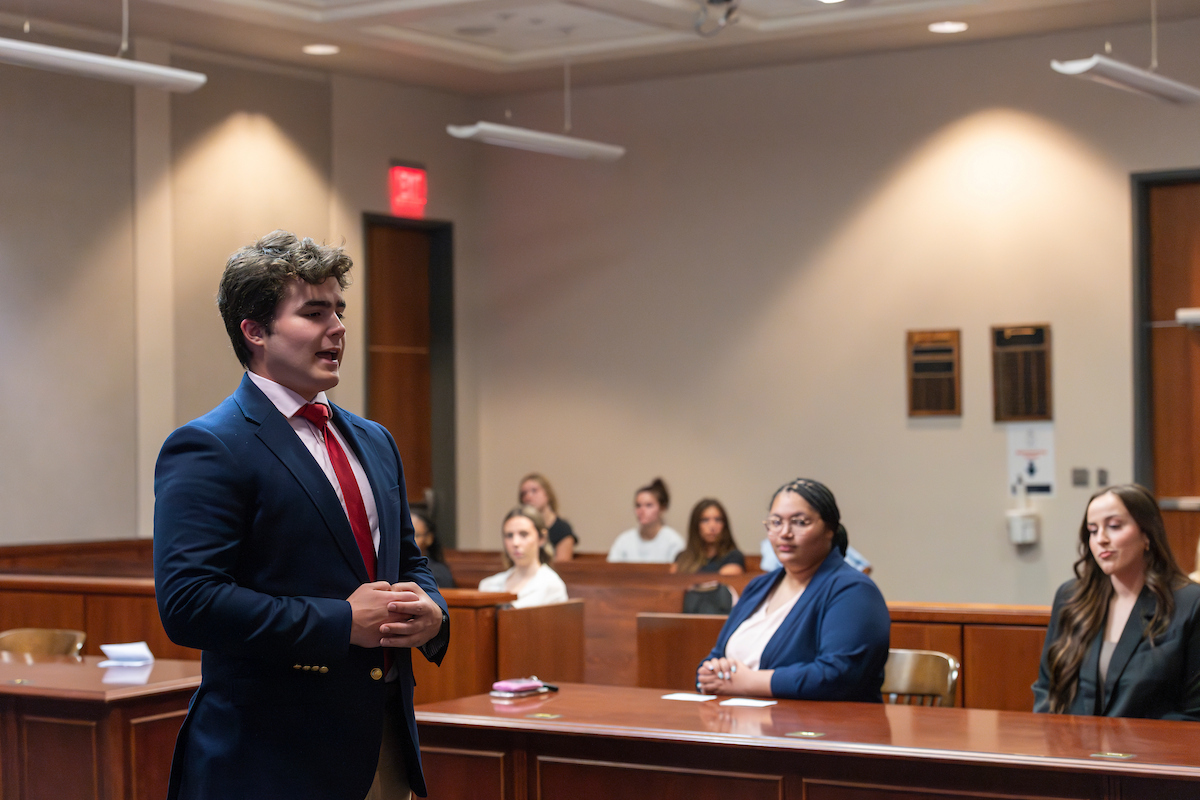
When the Mississippi Court of Appeals held court
at the UM Law School on April 13, the judges heard arguments on
one side from an experienced prosecutor and on the other side from
two UM law students arguing their first real case.
“The court considered this to be an excellent learning experience
for the students to see the court in action,” said Chief Judge
Leslie King, who along with the other judges on the panel passed
on sage advice to the student-packed courtroom.
Judges King, Donna Barnes, and David Ishee listened as third-year
law students LaDonna Curtis of Greenville and Jamie Jacks of Cleveland
argued the case for Mary Shields, convicted of a 2002 New Year’s
Eve murder and sentenced to life in prison by the Lowndes County
Criminal Court. The students argued that Shields’s offense
should be reduced to manslaughter.
“I think the students did a fantastic job,” King said.
“They were well prepared and familiar with the facts and the
law. They responded to each question by the judge clearly and never
lost focus. I’ve seen seasoned lawyers who could not stay
as focused.”
The Case: State v. Shields
On Dec. 31, 2002, Mary Shields entered a Columbus bar with a friend,
“St. Louis,” around 11 p.m. It is not clear who started
the fight that lasted approximately 20 minutes, but court records
show that at some point Shields and bar patron Larry Martin, who
had formerly lived with St. Louis, began fighting. When the fight
was over, Martin was dead.
Curtis and Jacks argued that Sheilds’s offense should be reduced
to manslaughter for many reasons, including that the bar fight was
mutual; a medical report showed that Martin had an underlying heart
condition that also contributed to his death; the act clearly meets
the language of heat-of-passion manslaughter; and eyewitness statements
were inconsistent.
Jacks argued that “there was no plain and strong likelihood
that death would follow” Shields’s actions.
The nine witnesses have various accounts of the night’s events.
Of the six eyewitnesses who testified, two did not remember seeing
Shields’s son join the fight. There are also mixed accounts
of a knife Shields had on her person and about who first picked
up a bar stool. The students argued that the Lowndes County jury
who convicted Shields did not truly understand the difference between
depraved-heart murder and heat-of-passion manslaughter.
“It is understandable that the jury was confused about this
depraved heart,” Curtis argued. “Even some of the great
legal minds of our state disagree on what depraved (heart means).”
In response, Assistant Attorney General Jeffrey Klingfuss argued
that Shields continued to beat Martin after he stopped trying to
defend himself and that there was no confusion in the minds of the
state and prosecutors about a depraved-heart murder. He stated it
was clear to the jury that there was no evidence of mutual combat.
“They call it mutual combat, we call it a killing,”
Klingfuss said.
Klingfuss noted the pathologist’s statement in the testimony
that Martin’s direct cause of death was blunt-force trauma
and that he may have died of a weak heart because of that trauma.
On cross-examination the same pathologist also stated that Martin’s
own involvement could have put higher demand for oxygen on his heart,
leading to his death.
Klingfuss also pointed to Shields’s physical power over Martin,
stating that she is a “formidable woman” at 5 feet 10
inches and 210 pounds, while Martin was 5 feet 8 inches tall and
weighed 165 pounds.
“She beat him with a bar stool until it broke,” Klingfuss
said. “She held it over her head and brought it down on Mr.
Martin.”
Klingfuss argued that since Shields never admitted guilt, then she
couldn’t claim manslaughter as there was nothing in the record
to support the charge.
Preparation Is the Key
Last fall, two students in UM’s Criminal Appeals Clinic, Audra
Lewis of Decatur, Ala., and Ashley Tullos of Hattiesburg filed a
brief on behalf of Mary Shields.
The two spent the entire semester researching and writing the brief,
and they met with Shields in prison. Although they were limited
to evidence in the court record, they wanted to hear her side and
her concerns. In the brief, the students argued that Shields lacked
the depravity and intent necessary to support a murder charge.
“Our appeal addresses the problematic Mississippi murder statute
wherein deliberate-design murder subsumes depraved-heart murder,”
Lewis said. “We addressed the difficulty facing even lawyers
— much less lay jurors — in determining the difference
between an act imminently dangerous evincing a depraved heart and
one done in the heat of passion.”
When the court agreed to hear oral arguments on the case, Phil Broadhead,
UM clinical professor and director of Criminal Appeals, chose Curtis
and Jacks to present the case.
They prepared by examining the case and researching applicable case
law. In the 10 days leading up to the argument, they brainstormed,
talked with Lewis about the brief, wrote and rehearsed their opening
statements, and practiced answering questions in front of a mock
panel composed of Broadhead and the two other clinical students,
Haley Broom and Lindsay Watts.
The day before the argument, the students presented their case to
a panel of three law professors.
“Our practices with our panel were a lot more intense than
the real day,” Curtis said. “They tried to box us in
with pointed questions.”
Broadhead praised the students for making his job easy.
“The months of planning that went into this event more than
went over my expectations,” he said. “The number of
law students that turned out and were engaged went beyond my expectations.
My students … are so bright (and) eager and have zeal to represent
their client to the best of their ability already.”
The
Clinic
The Criminal Appeals Clinic is part of the National Center for Justice
and the Rule of Law at the UM Law School. The clinic usually has
around eight students who work in groups of two writing briefs and,
if a case is accepted, arguing before the Court of Appeals.
The clinic was designed to give third-year law students practical
experience in criminal law and procedure by directly participating
in the pro bono representation of indigent persons in cases pending
before the state appellate courts.
“The purpose of the Criminal Appeals program is to help students
understand the art of appeal advocacy and to help the court in indigent
cases, for people who can’t afford representation,”
said Thomas Clancy, NCJRL director.
Since the Criminal Appeals Clinic began in 2002, students have filed
briefs in 15 cases, made four oral arguments and received two reversals
of circuit court decisions.
The first reversal was handed down by the Mississippi Supreme Court
in May 2004 and called for a new trial for Freddie Walker, a Jackson
man convicted of statutory rape and sentenced to two concurrent
life sentences.
The second came on May 25, 2004, when the Mississippi Court of Appeals
announced the reversal of Zachaira Dambrell’s conviction of
attempted armed robbery of a convenience store.
“The fact they did such a good job is a tribute to them and
the appellate program,” said Chief Judge Leslie King. “This
is a wonderful program that benefits the students and the state,
and I hope it will be continued.”
Q&A
After the court adjourned, the panel of judges took questions from
students who had gathered in the William N. Ethridge Jr. Moot Court
Room. Some of those questions and the panel’s responses are
included below.
Q: When is it a good idea for attorneys
to rely on facts of a case and when is it helpful to rely on the
law?
King: They used to say if the facts are on your
side, argue the facts, and if the law is on your side, argue the
law, and if neither is, then blow smoke. We laugh but it’s
true.
Q: What is your case load like?
King: Each year the average number of opinions
the Court of Appeals judges issue is 60. Each of us probably has
45 to 60 cases on an ongoing basis because they are consistently
being assigned.
Barnes: We vote on around 600 cases a year. Some
cases take up a lot of your time because you want to know what you
put your name on.
Q: What is your take on the argument
for appointed, versus elected, judiciary?
King: Having been elected, I prefer the elected
system. I don’t think there’s a substantial difference.
There is certainly politics (involved) in each one. If (the judge)
has a level of integrity then it won’t matter if (he or she
is) appointed or elected.
Q: How often does the way of presenting
facts create an ethical challenge?
King: By and large, the bulk of attorneys I’ve
seen have been honest people and are willing to tell the facts that
do and don’t favor them.
Barnes: If you misrepresent your record, opposing
counsel will point it out very harshly.
Ishee: Once you get the reputation for not being trusted, you’ll
find it’s hard to settle a case.
Q: Does the appearance, format and
thoroughness (of a brief) have an effect on you when you look at
it?
King: It is something you need to be aware of.
Keep in mind members of the court do an awful lot of reading. Judges
try to give every case the time it deserves, but the simple truth
is sheer volume can affect what you’re doing.
Q: Do you ever ask an attorney a question to “softball”
him or her?
King: I like to ask questions in which I really
want to know an answer. Some judges do ask questions to engage the
attorneys in conversation.
Q: Do you ever ask questions to make
a point to other judges?
King: I don’t.
Barnes: On our level we’re more a court of
correction of errors and not policy like the Supreme Court.
Q: Final advice to students?
Ishee: The main thing to remember is why you went to law
school in the first place. Here it’s easy to be idealists
but you have to remember that it is not about dollars and cents.
Barnes: Law is a tough profession. It takes many
hours, takes you away from your family, so work with people you
are comfortable with and that you can rely on.
King: I would say two things. One is to remember
that law is an honorable profession. Despite what others may say,
it is honorable and a profession. Second is to always make time
for yourself, family and friends. Time passes very swiftly.
Kara Givens is a senior journalism major
from Senatobia
Back
to top
|