|
|
Ready
for Prime Time
With regional and national success, UM's moot court team
is well prepared to channel their experience into real litigation.
by Elaine Pugh
Tobi Longwitz
Youth:
Born and reared in Midwest City, Okla. Graduate of Carl Albert High School.
College: Dartmouth College, two years; B.S. in political communications,
George Washington University; J.D., magna cum laude, The University of
Mississippi.
Career Decision: While at GWU, Longwitz worked for then U.S. Rep. J.C.
Watts (R-Okla.), moving up to the post of press secretary. "Seeing
how the law worked in Congress made me want to get more involved-to make
a difference." She was selected for the prestigious Attorney General's
Summer Honors Program at the U.S. Department of Justice in summer 2002.
Job: U.S. Department of Justice, Civil Rights Division, Attorney General's
Honors Program.
She is one of 10 new law graduates chosen from among some 3,000 applicants.

John Moses
Youth: Born in Brownsville,
Tenn., reared in Memphis. Graduate of Memphis
University School.
College: B.A. in English, The University of Mississippi; J.D., cum laude,
The
University of Mississippi.
Career Decision: An already published Southern literary-style writer,
Moses took a year off after undergraduate school "to get [his] thoughts
in order." A duck hunter and four-wheel drive truck fancier, he spent
the year working on a ranch in Jackson Hole, Wyo. "I thought about
a law degree a lot as an undergraduate because I love to read and write.
And I knew from my first year in law school that I wanted to litigate."
Job: Glankler Brown, Memphis
Vanessa Bird
Youth: Born in Memphis,
reared in Atlanta. Graduate of Marist High School.
College: University of Georgia, one year; B.A. in English, University
of Virginia; J.D., cum laude, The University of Mississippi.
Career Decision: Decided during third year of college that law school
might be in her future. She says she knew she wanted to practice in the
South, which, along with the small-town setting, is why she chose Ole
Miss. "Thank goodness I decided to go [to law school], and I haven't
regretted it. I know I want to do litigation, and I may want to try products
liability."
Job: Jones Day, Atlanta
May it please the court
," they
petitioned time and again throughout the 2002-03 National Moot Court Competition.
When it was over, The University of Mississippi Law School team had done
just that-pleased prying judges-winning the regional competition and making
a good showing nationally.
Through extraordinary efforts, Vanessa Bird, Tobi Longwitz, and John Moses,
under the guidance of Professor Matthew Hall, brought new acclaim to the
Law School's nearly 150-year-old moot court program.
"Congratulations are in order for our Dewees-Walsh National Moot
Court team, our moot court program, and Professor Hall, who did an outstanding
job coaching the team," says Dean Samuel M. Davis. "I am grateful
to Bill Dalehite ('72) for providing the financial support to sponsor
our team in this competition each year."
The 53rd annual competition involved 129 law schools in 14 regions across
the country. Sponsors were the Young Lawyers Committee of the Association
of the Bar of the City of New York and the American College of Trial Lawyers.
The UM team hit the ground running in Baton Rouge in November, winning
every round in the regional double elimination, beating such law schools
as the University of Tennessee, Vanderbilt University, Cumberland, and
Loyola. They also won the Best Brief Award. At nationals, held in January
in New York City, the UM team knocked out Georgetown and Boston University
before falling to the eventual champion, Wayne State.
The competition involved two constitutional issues that have divided the
Circuit Courts of Appeal and state appellate courts over the past few
years. The first considered whether an anonymous tip provides sufficient
suspicion under the Fourth Amendment to support a police officer's investigatory
stop of an automobile. The second centered on the Eighth Amendment's proscription
against cruel and unusual punishment and questioned whether a life sentence
imposed under a recidivist statute is disproportionate to the crime committed.
Expressing pride in the team's performance, Professor Hall says, "We
saw no team other than Wayne State that appeared even close to our students
in level of preparation or quality of
presentation.
"They possessed a firm understanding of the legal doctrine and theory
involved, but they also are fine orators. In other words, they are balanced
competitors, equally at home intellectually and as performers."
Taking on the extra work, the three 2003 honors graduates spent long hours
preparing for the competition.
"During the fall semester, over winter vacation, and during the beginning
of the spring semester, I would estimate that each member of the team
spent 200-250 hours working on this endeavor," Hall says. "In
addition to their abundant intelligence and commitment, they demonstrated
considerable poise, grace, and character in all their efforts."
All three members look forward to performing as real lawyers in real courtrooms.
Where most fledgling legal eagles learn to litigate through trial and
error, the trio agree their "trial by fire" moot court experience
has them raring to go.
"I no longer wonder if I'm ready to practice-I know I am," says
Moses. "Several of the judges made the comment that we did better
than a lot of lawyers they see in the courtroom, so that confidence for
me is the greatest thing that came out of the experience."
The competition also strengthened Bird's desire for a career in litigation,
which she says was the main reason she chose to attend law school. "I
thought it was something I could do well, given the opportunity. I'm highly
determined. I love dealing with people-getting up in front of people and
talking." The competition, she says, taught her how to "shift
gears mentally" in a way that is impossible to learn in a classroom
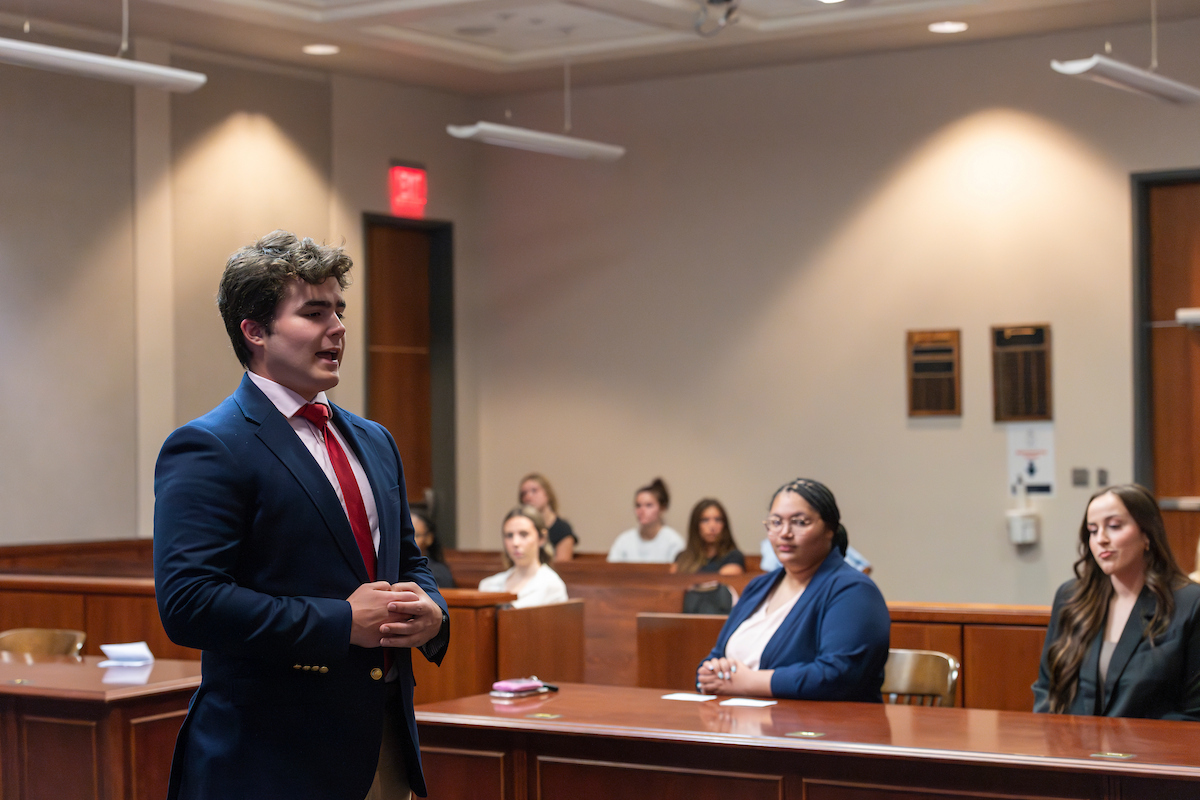
setting. "You've got to be up there, with the pressure on, the lights
on, with everybody staring at you, waiting for you to say something."
Longwitz, who admits to "being very nervous" about doing moot
court from the time she entered law school, says she ended up "really
enjoying it." "You're standing up there, and you have no idea
what questions are coming at you, so you learn to deal with it and just
make it through. That in itself is very empowering."
All three students praised their professor/coach for his dedication. "We
can't say enough about what Professor Hall did to help," says Longwitz.
"He put his whole self into it; he was our biggest critic and our
best fan."
"He really gave us so much time and energy," says Bird. "Not
only in helping us learn about the cases and particular areas of the law
but also in understanding how to organize arguments logically in our heads,
then feed off what a judge seemed to be understanding-or not understanding-and
how to transition in your mind from one line of argument to another."
Another plus was that the three had first met and become friends in the
same section of the 2000 entering class. "Everybody's personality
worked well together," says Bird. "When you really enjoy being
with somebody, then there's no dread of spending long hours together and
facing each other in practice."
In March, after the hoopla of winning had subsided, Longwitz and Moses,
in a twist of fate, enjoyed an unexpected extension of their moot court
experience. While in Washington attending "classes" at the Supreme
Court as members of Professor George Cochran's Supreme Court Practice
class, the court handed down its decision in Ewing v. California, one
of the two actual cases on which the moot court problem was based. And
in a rare occurrence, the ruling was read in court.
"They were speaking very familiar language, and it brought reality
to all that we had done," Moses says. "We saw that there actually
was an individual whose life was turned upside down in the courts."
Did he agree with the ruling? "The Supreme Court proportionality
test is-well, conservative is not a strong enough word. I would liberalize
that; judges should have more freedom under the Eighth Amendment."
Following the court's ruling, in an almost unheard of reading of a dissenting
opinion to the gallery, Justice Steven Breyer gave a show of passion,
cogently explaining why he thought the sentence imposed was both cruel
and unusual.
Back
to UMLawyer Home
|