|
|

Subject to Interpretation
Beware of making the Constitution a 'living document,' says U.S. Supreme
Court justice
The nation's eyes turned to the School of Law this spring
when U.S. Supreme Court Justice Antonin Scalia delivered the James McClure
Memorial Lecture and told the standing-room-only crowd to beware of the
concept of the Constitution as a "living document."
Scalia, 67, a conservative justice known for legal decisions based on
textual interpretation, said people who want change in society should
use the democratic process, not the courts, to bring it about. "What
makes you think that a living Constitution is going to evolve in the direction
of greater freedoms?" Scalia asked. "It could evolve in the
direction of less freedom, and it has."
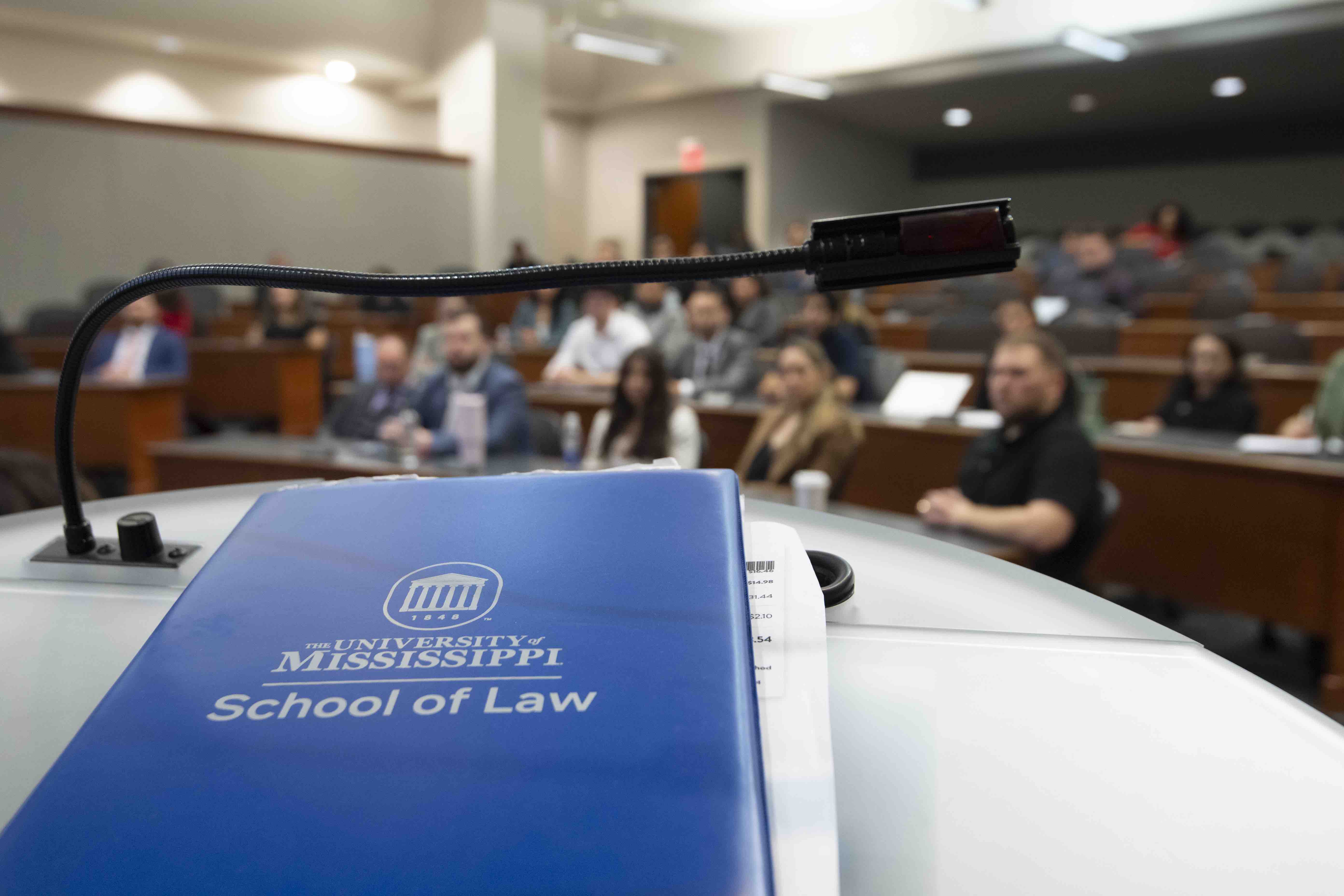
The controversial jurist drew more than 900 students, faculty, staff,
and others to Fulton Chapel April 10. While many in the crowd were law
school students, much of the audience, and others outside, just wanted
to hear what Scalia would say. Scalia, a Reagan appointee who has served
on the nation's highest court since 1986, has angered both liberals and
conservatives at times with his opinions. In 1989, he cast the deciding
fifth vote in Texas v. Johnson, the decision that struck down laws against
burning the American flag. At the time, conservatives were incensed. Thursday
afternoon, Scalia told the UM crowd in that case and others, he was handcuffed
by the Constitution.
"I would have been delighted to throw Mr. [Gregory Lee] Johnson in
jail," Scalia said of the man tied to the flag case. "Unfortunately,
as I understand the First Amendment, I couldn't do it." While Scalia's
literal interpretation protects those rights expressly written by the
framers in 1791, he said he doesn't recognize rights that many people
today take for granted as constitutional. For instance, Scalia, a devout
Catholic and father of nine, has vigorously opposed abortion on the grounds
that it's not a right guaranteed specifically by the Constitution, even
though some justices interpret otherwise.
But
this kind of interpretation, Scalia says, goes far beyond their role as
jurists and turns justices into policy makers, which in turn pollutes
the selection process. Scalia referenced the embattled Bush nominations
to the U.S. Court of Appeals.
"People have finally figured out ... that judges aren't interpreting
law anymore, they're making policy," Scalia says. "So I don't
want a good lawyer, I want someone who agrees with me. "We'll have
to have a mini-constitutional convention every time they select a new
justice of the Supreme Court."
Outside Fulton Chapel, about 15 students from the campus chapters of the
National Organization for Women and the Gay, Lesbian and Bisexual Association
staged a quiet protest. "There are several important cases in front
of the court right now," said Amy Clukey, president of UM's NOW and
a senior from Deltona, Fla. "Sodomy laws, affirmative action at the
University of Michigan, and of course, abortion rights are always an issue."
Chris Kelly from Sherman carried a sign that read "Sodomy Laws are
against basic human freedoms." "I wanted to take the opportunity
to speak up for those who are unwilling or unable to speak up for themselves,"
Kelly says. Inside the auditorium, Scalia drew fire from the other side
of the political spectrum when he opened the floor to questions. Jim Giles
of Richland, a private citizen and outspoken proponent of conservative
causes, had driven to campus for the speech. He thundered at Scalia that
the University's ban of flags on sticks in Vaught-Hemingway Stadium was
just a "pretext to ban the Confederate flag. How isn't that unconstitutional?"
Scalia paused, then answered slowly, with a wave of his hand. "I
have no idea."
The crowd laughed and applauded.
After the speech, second-year law students Brett McColl of Toledo, Ohio,
Joey Long of Henderson, N.C., and David Ford of Memphis said Scalia argued
so convincingly for literal constitutional interpretation that they wished
another legal scholar had been available to present a counterpoint. "I
generally disagree with just about everything the man writes, but he's
definitely intelligent and knows the law," McColl says.
According to Scalia, knowing the law and how to apply it is his only job.
"People who want to read one new law into the Constitution after
another, from abortion rights to grandparents' rights, are not looking
for a flexible government," he said. "They're looking for rigidity."
This was Scalia's third appearance in the McClure Lecture Series and the
sixth time a U.S. Supreme Court justice has presented the lecture. Henry
Blackmun delivered it in 1982, Sandra Day O'Connor in 1988, and Clarence
Thomas in 1995.
The series was established by James McClure Jr. of Sardis and Tupper McClure
Lampton of Columbia in honor of their father, a Sardis attorney and UM
Law School alumnus.
Back
to UMLawyer Home
|